
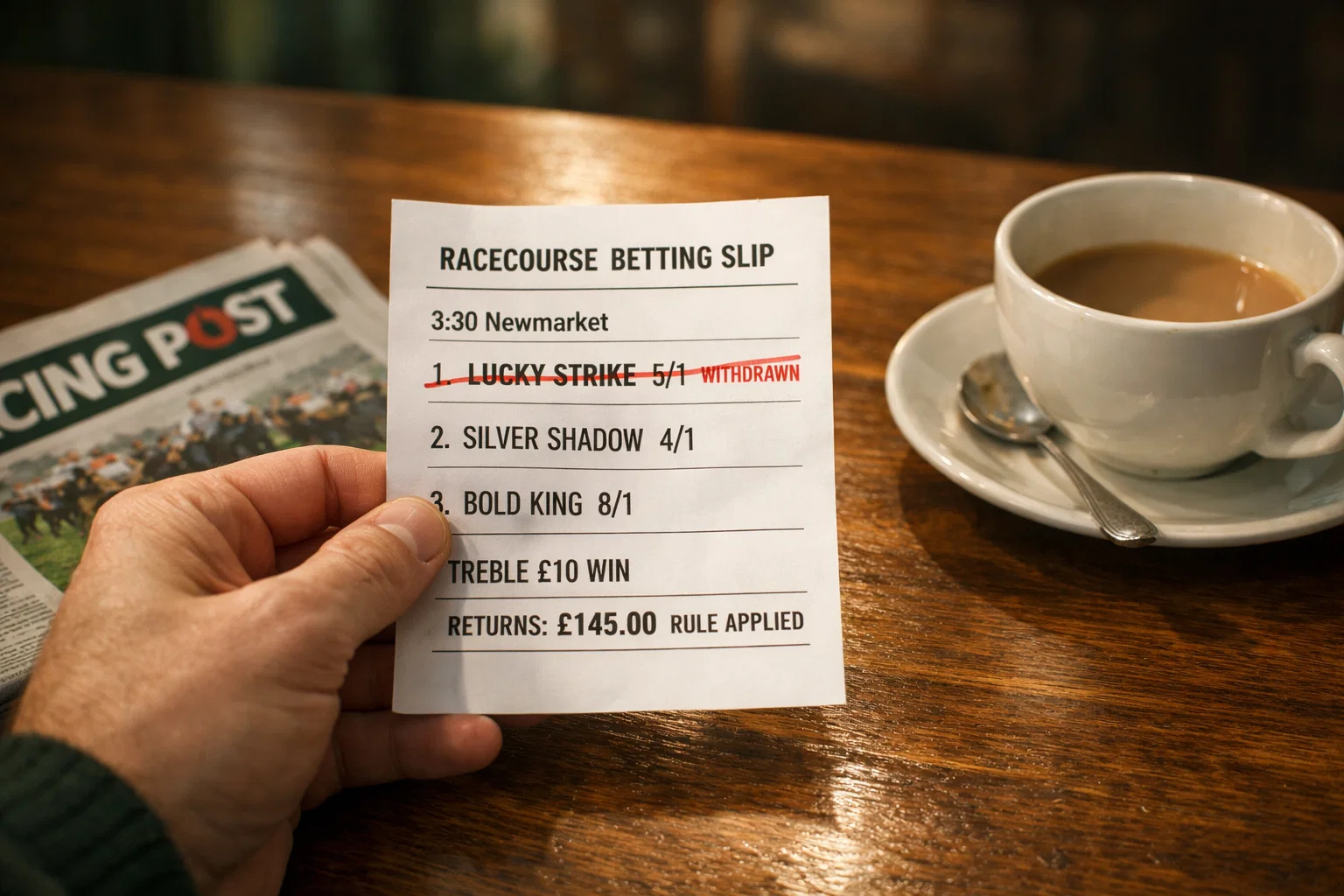
You backed the winner. The horse crossed the line first, your selection was spot-on, and for a brief, glorious moment the world made sense. Then you checked your payout and noticed it was lighter than expected. Welcome to Rule 4 deductions in horse racing — the mechanism that quietly trims your winnings whenever a non-runner is withdrawn from the race after betting has opened.
Rule 4 exists because a withdrawal reshapes the entire market. When a horse is pulled from a race, the remaining runners become more likely to win, which means the original odds no longer reflect reality. Rather than void every bet and start fresh — which would be chaos on a busy Saturday card — Tattersalls Rule 4(c) applies a standardised deduction to winning payouts. The deduction follows the withdrawn horse’s price, not yours. That distinction matters, and misunderstanding it is one of the most common frustrations among punters seeing less in their accounts than they expected.
This guide breaks down exactly how Rule 4 works, what gets taken from your winnings, and where different bookmakers diverge in how they settle these deductions. If you have ever stared at a betting slip wondering where your money went, this is the page to bookmark.
How Rule 4 Deductions Actually Work
Tattersalls Rule 4(c) has been part of British racing’s settlement framework for decades, originally designed by the Tattersalls Committee — the body responsible for adjudicating disputes between bookmakers and punters. The rule was never intended to punish winners. It was built to correct a mathematical distortion that occurs when the field shrinks after prices have already been set.
Here is the core principle: when a horse is withdrawn from a race, the probability of any remaining horse winning goes up. If a 3/1 shot is pulled out, that probability has to be redistributed across the remaining field. The bookmaker’s original odds now overstate the true risk, meaning payouts based on those odds would be more generous than the market warrants. Rule 4 fixes this by deducting a set number of pence per pound from your winnings, scaled to the price of the withdrawn horse.
Critically, the deduction is determined by the starting price of the non-runner — the horse that left the race — not the price of your selection. If you backed a 10/1 outsider and the 2/1 favourite was withdrawn, the deduction reflects the favourite’s price because that is where the biggest chunk of market probability sat. Lose the favourite and the remaining field absorbs a large share of implied probability, so the deduction is steep. Lose a 33/1 outsider and the redistribution is negligible, which is why the deduction for long-priced withdrawals is minimal or zero.
The timing matters too. Rule 4 only applies when the withdrawal occurs after the final market has been formed — typically once betting has opened for the race. If a horse is declared a non-runner well before the off and the market has time to re-form, bookmakers may choose to re-price the remaining field rather than apply a deduction. In practice, most on-the-day withdrawals trigger Rule 4 because they happen close enough to the off that the market cannot fully adjust.
There is a practical nuance about how the deduction interacts with each-way bets. If you place an each-way bet and a non-runner is declared, Rule 4 applies to both the win part and the place part of your bet. The deduction rate is the same for both — it does not change because you are collecting place money rather than the win. If you backed a horse each-way at 10/1 and collected on the place only, the 25p deduction from a withdrawn 3/1 shot still applies to your place winnings at the reduced fraction (typically a quarter or a fifth of the odds). This can make the place return feel particularly thin, because the place odds were already modest before the deduction shaved them further.
One more thing worth understanding early: Rule 4 applies to your winnings, not your stake. If you place a £10 bet at 5/1 and there is a 20p deduction, you still get your £10 stake back. The deduction is taken from the £50 profit portion. This sounds obvious, but it catches people out more often than you would think.
The Full Rule 4 Deduction Table
The table below is the single most useful reference you will find for Rule 4 settlements. It shows the deduction applied per pound of winnings based on the starting price of the withdrawn horse. Every licensed bookmaker in Britain uses these bands, though the precise way they round or apply minimums can vary slightly — more on that later.
| Price of Withdrawn Horse | Deduction (pence per £1) |
|---|---|
| 1/9 or shorter | 90p |
| 2/11 to 2/17 | 85p |
| 1/4 to 1/5 | 80p |
| 3/10 to 2/7 | 75p |
| 2/5 to 1/3 | 70p |
| 8/15 to 4/9 | 65p |
| 8/15 to 4/7 | 60p |
| 8/13 to 4/6 | 55p |
| 20/21 to 5/6 | 50p |
| Evens to 6/5 | 45p |
| 5/4 to 6/4 | 40p |
| 8/5 to 7/4 | 35p |
| 9/5 to 9/4 | 30p |
| 12/5 to 3/1 | 25p |
| 16/5 to 4/1 | 20p |
| 9/2 to 11/2 | 15p |
| 6/1 to 9/1 | 10p |
| 10/1 to 14/1 | 5p |
| Over 14/1 | No deduction |
Reading the table is straightforward: find the starting price of the horse that was withdrawn, look across to the deduction column, and that tells you how many pence will be deducted per pound from your winnings. A withdrawn horse priced at evens triggers a 45p deduction. A withdrawn horse priced at 10/1 triggers just 5p. A withdrawn horse at 16/1 or longer costs you nothing.
If you use decimal odds, you will need to convert before consulting the table. Evens is 2.00 in decimal, 3/1 is 4.00, 10/1 is 11.00, and so on. The deduction remains the same regardless of format — only the way you identify the price bracket changes. Most bookmaker apps display fractional and decimal odds side by side, which makes the conversion trivial.
The logic behind the gradient is intuitive once you see it. Short-priced horses carry a large share of the market’s implied probability. When a 1/4 favourite is withdrawn, the redistribution across the remaining field is enormous — hence the 80p deduction. When a 12/1 outsider walks out of the paddock, the redistribution is small, and 5p reflects that.
There is a ceiling. No matter how many horses are withdrawn from a single race, the maximum cumulative deduction cannot exceed 90p in the pound. In other words, you will always receive at least 10% of your winnings. This cap exists specifically to protect punters when multiple withdrawals hit the same race — a situation that is rare but not unheard of at major festivals.
Worked Examples: Calculating Your Rule 4 Deduction
Example 1: Short-Priced Non-Runner
You place a £20 win bet on Horse A at 4/1. Before the race, Horse B — the 6/4 joint-favourite — is withdrawn after failing a pre-race veterinary inspection. Consulting the table, a horse at 6/4 falls in the 5/4 to 6/4 band, which triggers a 40p deduction.
Without Rule 4, your winnings would be £80 (£20 x 4/1). With the deduction, you lose 40p per pound of those winnings: £80 x 0.40 = £32. Your adjusted winnings are £80 minus £32, which equals £48. Add your £20 stake back, and the total return is £68 instead of £100. That £32 sting is noticeable, and it lands entirely because the withdrawn horse was short-priced — not because your selection was priced poorly.
To put it another way: you picked the right horse, but because someone else’s horse left the race, you lost 40% of your profit. If the favourite had been withdrawn before the market opened, the remaining runners would have been repriced and you would have simply received shorter odds on Horse A — perhaps 3/1 instead of 4/1. Rule 4 is the imperfect but necessary substitute for that repricing when the withdrawal happens too late for the market to adjust.
Example 2: Long-Priced Non-Runner
Same bet — £20 on Horse A at 4/1 — but this time the withdrawn horse was a 12/1 outsider. The deduction for a horse priced between 10/1 and 14/1 is just 5p in the pound.
Your winnings are still £80. The deduction: £80 x 0.05 = £4. Adjusted winnings: £76. Total return with stake: £96. Barely a scratch. The 12/1 shot carried minimal implied probability, so its removal barely changes the remaining field’s chances. And if the non-runner had been priced at 16/1 or longer, you would have paid nothing at all. For long-priced withdrawals, Rule 4 is little more than an administrative footnote.
Example 3: Multiple Non-Runners in One Race
Now suppose two horses are withdrawn from the same race. Horse B was priced at 3/1 (25p deduction) and Horse C at 5/1 (15p deduction, as 5/1 falls within the 9/2 to 11/2 band). The deductions stack: 25p + 15p = 40p in the pound.
Your £20 bet on Horse A at 4/1 generates £80 in winnings. The cumulative deduction: £80 x 0.40 = £32. Adjusted winnings: £48. Total return: £68. That is a substantial trim, and it illustrates why multiple withdrawals can turn a winning day into a frustrating one. But remember the ceiling — even if the deductions added up to more than 90p, the maximum would cap at 90p per pound. On £80 winnings, the worst-case deduction would be £72, leaving you with at least £8 in profit plus your £20 stake.
These examples use clean numbers for clarity. In reality, bookmakers apply Rule 4 to the exact penny, and decimal odds users will see the same percentages expressed differently. The maths does not change — only the notation does.
Multiple Non-Runners: How Deductions Stack
When two or more horses are withdrawn from the same race, Rule 4 deductions are applied cumulatively — as Example 3 above illustrated. But there is more to the mechanics of stacking than a single worked example can show, particularly around the protective cap that prevents deductions from swallowing your entire payout.
This stacking is where the 90p cap becomes essential. Without it, a race with three short-priced withdrawals could theoretically generate deductions exceeding 100p in the pound, which would mean you owed the bookmaker money for winning. The Tattersalls Committee recognised this absurdity and set the ceiling at 90p, guaranteeing that winning punters always collect at least 10% of their original winnings regardless of how many horses leave the field.
In practice, multiple non-runners are most likely at major festivals where large fields attract diverse entries. The 2024 Cheltenham Festival was a sharp reminder: trainer Nicky Henderson was forced to withdraw seven or more horses from Seven Barrows due to an illness spreading through his yard. In races where more than one of those runners had been among the market principals, cumulative deductions would have been significant for anyone backing the remaining runners at early prices.
There is a tactical point here. If you see one non-runner declared and the market begins to adjust, consider that a second withdrawal — particularly in Jump races during wet winters — is not improbable. Waiting for the market to settle before placing your bet means the odds you take already reflect the withdrawals, and no Rule 4 deduction applies to those adjusted prices. The trade-off is that you may get shorter odds, but you avoid the surprise of a post-race haircut.
The each-way angle matters here as well. When multiple withdrawals shrink the field below certain thresholds, bookmakers can reduce each-way place terms or remove them entirely. A race that was paying four places might drop to three, or three might drop to two. Combined with cumulative Rule 4 deductions on whatever you do win, the economics of an each-way bet in a race with multiple withdrawals can deteriorate quickly. Always check the revised place terms after non-runners are declared.
Some punters prefer to take early prices for value and accept the Rule 4 risk. Others wait until the final declarations are confirmed and the market has stabilised. Neither approach is wrong — but understanding cumulative deductions helps you make that decision with your eyes open rather than discovering the maths after the result.
Do All Bookmakers Apply Rule 4 the Same Way?
The deduction table itself is standardised, but the way bookmakers implement it is not perfectly uniform. The differences are subtle, and most casual punters will never notice them. But if you are betting in volume or at significant stakes, these variations can add up across a season.
The first variation concerns the minimum deduction threshold. Some bookmakers apply a minimum 5p deduction even when the withdrawn horse’s price would normally warrant no deduction at all. Others follow the table literally and apply zero when the non-runner is priced over 14/1. Check your bookmaker’s terms and conditions — the minimum deduction policy is usually buried in the settlement rules.
The second variation involves timing. Bookmakers that settle at starting price (SP) apply Rule 4 based on the SP of the withdrawn horse at the time of withdrawal. Those that allow early-price locking may apply different deduction calculations depending on when you placed your bet relative to when the non-runner was declared. If you took an early price at 9am and the horse was withdrawn at 1pm, the Rule 4 deduction is typically based on the price at the time of withdrawal, not the price when you placed the bet.
Then there is the exchange. Betfair does not use Rule 4 at all on its exchange platform. Instead, it applies a reduction factor — a percentage-based adjustment unique to each horse, calculated from its implied probability in the market. The reduction factor is frozen approximately 15 minutes before the off, and any horse whose factor falls below 2.5% is treated as a non-material runner with no adjustment applied. This is a fundamentally different system from the flat-rate Tattersalls table, and it often produces different outcomes. A withdrawn 5/1 shot might cost you 15p in the pound with a bookmaker under Rule 4, but the reduction factor on Betfair for the same horse might be 12.7% — close, but not identical.
Betfair Sportsbook, by contrast, operates like a traditional bookmaker and does apply standard Rule 4. This catches out punters who assume the exchange and the sportsbook follow the same rules. They do not.
The broader market context matters here. According to Gambling Commission data for the year ending March 2025, remote betting on horse racing generated £766.7 million in gross gambling yield. That is a substantial market, and the way deductions are applied across it is not trivial. As Richard Wayman, BHA Director of Racing, noted in 2025: “Total betting turnover has fallen by nine per cent compared with the same period in 2024” — a decline driven by multiple factors including regulatory pressure and punter migration to unlicensed platforms.
That migration point is worth pausing on. According to Racing Post’s Big Punting Survey in 2025, one in three punters staking £1,000 or more reported using an unlicensed site in the previous twelve months. On unlicensed platforms, Rule 4 may not be applied at all — or it may be applied inconsistently. Whatever the odds advantage, the lack of regulatory oversight means dispute resolution is effectively non-existent. Licensed bookmakers apply Rule 4 transparently; unlicensed operators make their own rules.
For the average punter, the practical advice is simple: know whether your bookmaker settles at SP or locks early prices, understand whether they apply minimum deductions, and if you use Betfair, know the difference between the exchange reduction factor and the sportsbook’s standard Rule 4. These details will not make or break a single bet, but over hundreds of bets across a season, they shape your returns in ways that compound.
What Rule 4 Means for Your Betting Routine
Rule 4 deductions are one of those mechanisms that every racing punter encounters but few truly understand until it costs them. The principle is straightforward — when a horse is withdrawn, the remaining field’s chances improve, and your payout is adjusted accordingly. The deduction follows the withdrawn horse’s price, not yours, and the maximum combined deduction in any race is capped at 90p in the pound.
Working this knowledge into your betting routine takes two habits. First, check for non-runners before you finalise your bet. Final declarations for most races are confirmed 48 hours out, and on-the-day withdrawals are published through the Racing Admin System and bookmaker feeds. If you spot a short-priced withdrawal, you can estimate the deduction from the table and decide whether the value in your selection still holds after the trim. Second, check after the race. Compare your payout to what you expected. If the numbers do not match, Rule 4 is almost always the reason — and now you know how to verify the calculation yourself.
There is a broader habit here too, one that separates recreational punters from those who take the game seriously. Every time a non-runner is declared, the race changes. Not just the odds, but the pace, the draw, the tactical dynamic between the remaining runners. Rule 4 is the financial expression of that change — a blunt but necessary correction to a market that no longer matches reality. The punters who treat non-runners as information rather than inconvenience tend to be the ones whose accounts survive the long run.
Horse racing is a sport of margins. A length here, a nose there, a price shift in the final minutes before the off. Rule 4 is another margin — one that sits between you and the full return your selection earned. Understanding it does not eliminate the deduction, but it removes the surprise. And in betting, surprises you did not plan for are the expensive ones.