
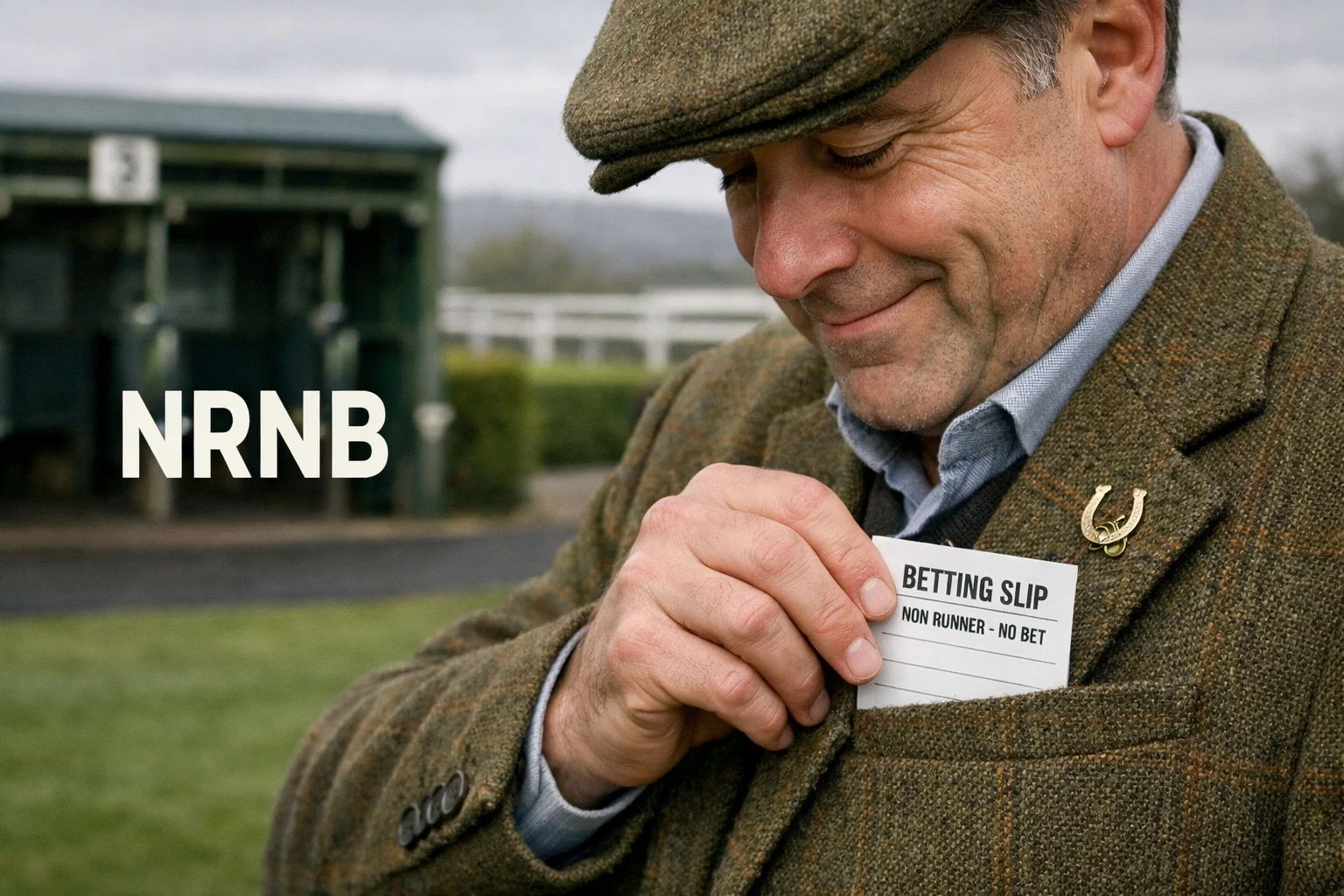
Every ante-post punter knows the dread. You spot a horse months before a festival, back it at a generous price, and then — days, sometimes hours, before the race — it is withdrawn. Under standard ante-post rules, your stake is gone. Not reduced, not returned, just gone. Non-Runner No Bet is the industry’s answer to that particular flavour of misery.
NRNB — sometimes marketed as Non-Runner Money Back — is a promotional condition offered by bookmakers that returns your stake if your selection becomes a non-runner. It applies specifically to ante-post markets where, without the promotion, you would lose everything. Think of it as insurance for your ante-post stake: it costs you something in the form of shorter odds, but it protects you from the total wipeout that a withdrawal would otherwise cause.
The concept sounds simple. The detail is where it gets interesting — and where the value calculation for serious punters actually lives. Not all NRNB offers are created equal, the markets they cover vary between bookmakers, and the price you pay for that protection differs depending on when you bet and which firm you use. What looks like a generous safety net can, in certain circumstances, cost you more than it saves. This guide takes apart every moving piece so you can decide when NRNB is worth the premium and when you are better off without it.
How Non-Runner No Bet Actually Works
To understand what NRNB adds, you first need to understand what happens without it. In a standard ante-post market, your bet is placed at a fixed price before the final declarations. If the horse runs, your bet stands at those odds. If the horse does not run, you lose your stake — no refund, no void, no consolation. The bookmaker keeps your money because the generous early price you received already accounted for the risk that the horse might not make it to the start.
This is a legitimate trade-off. Ante-post odds are longer than day-of-race prices precisely because they carry withdrawal risk. A horse quoted at 8/1 ante-post might be 5/1 on the morning of the race once the field is confirmed and the doubt is removed. The difference in price is the market’s way of pricing in uncertainty.
NRNB changes the deal. When a bookmaker offers Non-Runner No Bet on a market, they are saying: if your horse is withdrawn before the race, we will return your stake in full. You no longer carry the risk of losing everything to a non-runner. The catch — and there is always a catch — is that NRNB odds are shorter than the equivalent standard ante-post price. That compressed price is the premium you pay for the protection.
It is worth distinguishing NRNB from the day-of-race refund that applies to all bets. If you place a bet on the morning of the race and your horse is subsequently withdrawn, your stake is automatically returned under standard bookmaking rules — you do not need NRNB for that. NRNB only matters in the ante-post window, the period before final declarations when the field is not yet confirmed. Once declarations close and the runners are locked in, NRNB’s role is over — at that point, your bet is either live or already refunded.
The activation is typically automatic. If your horse becomes a non-runner, the bookmaker voids the bet and returns your stake as cash. Some firms return it as a free bet instead, which introduces a subtle but important difference in value. A £50 stake returned as cash is worth £50. A £50 free bet is worth less, because free bet returns usually exclude the stake from winnings. Always check whether NRNB refunds come back as cash or credit — the distinction affects the true cost of the insurance.
There is also the question of timing. Most NRNB offers have windows — they might only apply to bets placed before a certain date, or they might activate once a bookmaker decides to open the NRNB market for a specific race. Miss the window and your ante-post bet reverts to standard terms: no run, no refund, no recourse.
NRNB Markets vs Standard Ante-Post: A Direct Comparison
The easiest way to grasp the trade-off is to put the two options side by side. Take a hypothetical scenario: a Grade 1 race at Cheltenham Festival, three months before the event. You fancy a horse and want to back it early.
Under standard ante-post terms, the horse is available at 10/1. Under the NRNB market, the same horse is priced at 7/1. Both bets are for £50.
If the horse runs and wins, your standard ante-post bet returns £550 (£500 profit plus £50 stake). The NRNB bet returns £400 (£350 profit plus £50 stake). The difference — £150 — is the price you paid for the protection. If the horse runs and loses, both bets lose £50. No difference there.
But if the horse is withdrawn, the outcomes diverge sharply. Your standard ante-post bet is dead — you lose £50 with no return. Your NRNB bet returns your £50 stake in full. Over one bet, the gap is £50. Over a festival season where you might place a dozen ante-post selections, the cumulative protection can be substantial.
The question punters have to answer is whether the probability of a non-runner is high enough to justify the shorter price. If you believe the horse has, say, a 15% chance of being withdrawn before the race — not unreasonable for a Jump horse in winter — then the expected value of the NRNB protection can be calculated. On a £50 bet, a 15% chance of losing the full stake represents an expected cost of £7.50. If the odds difference between ante-post and NRNB amounts to more than that, standard ante-post is better value. If less, NRNB wins mathematically.
In practice, most punters do not run expected-value calculations before every bet. But the framework is useful: NRNB is not free insurance, and it is not always the best choice. It depends on the probability of withdrawal, the size of the odds gap, and your tolerance for risk. For casual punters making one or two festival bets, the peace of mind alone may be worth the price. For volume ante-post bettors, the cumulative odds compression can erode long-term returns if withdrawals turn out to be infrequent.
There is a third option that some sharp punters use: placing a standard ante-post bet at the bigger price and then laying the horse on the exchange if withdrawal looks likely — effectively creating DIY insurance. This approach requires exchange access, some knowledge of lay betting, and the willingness to manage the position. It is not for beginners, but it illustrates the point that NRNB’s value is always relative to the alternatives available.
Which Bookmakers Offer NRNB and on Which Markets?
NRNB availability varies significantly between bookmakers. Some offer it as a permanent feature on selected ante-post markets. Others roll it out seasonally, tying it to specific festivals or high-profile races. A few treat it purely as a promotional tool, switching it on and off with little notice.
The major UK bookmakers — Bet365, William Hill, Paddy Power, Betfred, Sky Bet, Coral, and Ladbrokes — all offer NRNB in some form, but the scope and terms differ. Some cover only Grade 1 and featured handicap races at the big festivals. Others extend NRNB to a wider range of ante-post markets throughout the season. The races most commonly covered include the Champion Hurdle, the Gold Cup, the Grand National, the King George, and the feature races at Royal Ascot.
What separates the offers is not just which races they cover but the conditions attached. Key variables include whether the refund is returned as cash or a free bet, whether there is a maximum stake limit, whether each-way bets are covered in full or only the win part, and how far in advance the NRNB market opens. Some bookmakers impose time windows — NRNB might only apply to bets placed in a specific week — while others keep the market open until final declarations.
It is worth noting the commercial context behind these offers. Total betting turnover on British racing fell by 6.8% in 2024 compared with the previous year, according to BHA’s full-year 2024 Racing Report. Online turnover specifically has dropped by an estimated £1.6 billion since 2022, a figure that, adjusted for inflation, represents an even steeper real-terms decline. In that environment, NRNB serves a dual purpose for bookmakers: it protects the punter from withdrawal risk, but it also encourages early engagement with ante-post markets at a time when overall betting volumes are shrinking.
Nevin Truesdale, the former CEO of the Jockey Club, framed the regulatory backdrop bluntly in 2025 when he told the Racing Post that the Gambling Commission’s approach appeared to be steering the industry toward small-stakes participation. Whether or not you agree with that characterisation, the pattern is clear — bookmakers are fighting harder for ante-post money, and NRNB is one of the most visible weapons in that fight.
For punters, the practical takeaway is to compare not just odds but terms. A bookmaker offering NRNB at 8/1 with a cash refund is giving you a materially better deal than one offering 8/1 with a free bet return, even though the headline price looks identical. Check the small print before the odds comparison.
NRNB at Cheltenham, Grand National & Royal Ascot
NRNB reaches its maximum utility around the major National Hunt and Flat festivals. These are the weeks when ante-post markets are busiest, withdrawal rates historically spike, and the stakes — both financial and emotional — are highest.
Cheltenham Festival is the prime case. In 2024, trainer Nicky Henderson was forced to withdraw seven or more horses from Seven Barrows after an unidentified illness swept through his yard. The casualties included Jonbon from the Champion Chase, Shishkin from the Gold Cup, and Constitution Hill from the Champion Hurdle — all among the most heavily backed ante-post selections of the week. Oddschecker estimated the potential lost prize money at around £1.3 million. For punters who had backed those horses ante-post without NRNB, the losses were total and unrecoverable.
That scenario is not a freak event. Cheltenham in March coincides with the tail end of winter, when respiratory infections, soft ground, and training setbacks create the perfect conditions for late withdrawals. The 2025 Festival carried a total prize fund of £4.93 million, and hundreds of millions of pounds are wagered across the four days. When that much money is in play and withdrawal risk is elevated, NRNB stops being a nice-to-have and becomes a genuine strategic consideration.
The Grand National presents a different dynamic. The race’s unique 72-hour declaration window — extended from the standard 48 hours for 2026, with the number of reserves increased from four to six — means that the field can shift significantly in the days before the race. Ante-post punters face a longer window of uncertainty, which makes NRNB particularly relevant. In 2024, two horses were withdrawn on the day of the race itself, after the field had already been reduced from the traditional maximum of 40 to a new safety-capped limit of 34. For anyone who had backed either of those horses months in advance without NRNB, the result was a total loss on what should have been the highlight of the racing calendar.
Royal Ascot is the Flat’s equivalent. Big-field handicaps like the Wokingham and the Royal Hunt Cup attract large ante-post interest, and the going can change dramatically in the days before the meeting depending on weather and watering decisions. Ascot’s Group 1 races also see late withdrawals from international raiders who may ship over only to find the ground unsuitable.
The seasonal pattern of UK betting participation reinforces why festivals matter so much. Gambling Commission survey data from the April–July 2025 period showed that 7% of UK adults had bet on horse racing in the previous four weeks, compared with just 4% in the January–April window. That seasonal jump coincides precisely with Cheltenham, the Grand National, and the early Flat season. More punters, more ante-post bets, and a greater aggregate exposure to withdrawal risk — all of which makes NRNB more relevant during these peaks than at any other point in the calendar.
The Catch: NRNB Limitations You Should Know
NRNB is marketed as a benefit, and it is — but it comes with strings that are easy to overlook when the Festival ante-post markets are buzzing.
The most significant limitation is the price compression. NRNB odds are almost always shorter than standard ante-post odds, often by a meaningful margin. A horse at 12/1 in the standard market might be 8/1 or 9/1 in the NRNB market. Over time, that difference compounds. If you back ten ante-post horses across a season using NRNB and only one of them is withdrawn, the cumulative odds shortening across the nine that ran may outweigh the value of the one refund you received. The insurance cost is hidden in the price, and it is always there whether you need it or not.
Market availability is another constraint. Not every race gets an NRNB market. Bookmakers tend to offer it on high-profile events — the Gold Cup, the Champion Hurdle, the Grand National — but rarely on smaller Grade 2 or listed races where ante-post interest is lower. If the race you are interested in does not have an NRNB option, you are back to standard terms.
Timing restrictions apply too. Some bookmakers only open their NRNB markets during a promotional window. Miss the window — because you were waiting for a trial run, or because the bookmaker only activated the offer at short notice — and you cannot retrospectively convert a standard ante-post bet into an NRNB one. The terms are set at the point of placement, not at the point of withdrawal.
Maximum stake limits are common. A bookmaker might cap NRNB bets at £25 or £50, which is fine for recreational punters but meaningless for anyone betting in volume. If you are trying to get £200 on at NRNB terms, you may need to spread across multiple firms, which introduces its own complications.
Each-way NRNB is particularly tricky. Some bookmakers apply NRNB to the full each-way stake — both win and place — while others only cover the win portion. If you place a £50 each-way bet (£100 total outlay) and your horse is withdrawn, one bookmaker might return the full £100 while another returns only £50. That is a significant difference, and it is not always clear from the promotional material which approach applies.
Finally, there is the free-bet trap mentioned earlier. If your NRNB refund comes back as a free bet rather than cash, its real value is lower. A £50 free bet on a 4/1 winner returns £200 profit — but not your £50 stake. A £50 cash refund, reinvested at 4/1, returns £250 total. The difference is not trivial over the course of a season. Before committing to an NRNB bet, verify what form the refund takes. This single detail can shift the entire value equation.
When to Use NRNB — and When to Skip It
Non-Runner No Bet is insurance for your ante-post stake, and like all insurance, it has a cost. The protection is real — getting your money back when a horse is withdrawn is materially better than losing it — but the premium is baked into the shorter odds, and it compounds across multiple bets.
The smart use of NRNB is selective, not automatic. It makes the strongest case when the probability of withdrawal is elevated: during the winter Jump season when ground conditions are volatile, at festivals where large yards bring multiple entries that may not all make it, and in races with long ante-post windows where a lot can go wrong between the bet and the off. In those scenarios, the insurance is priced closer to its fair value, and the peace of mind is a genuine asset.
Where NRNB makes less sense is on bets where withdrawal risk is low — mid-summer Flat races on good ground, for instance, or short-priced favourites whose connections have every incentive to run. In those cases, you are paying for protection against an event that is unlikely to happen, and the odds compression eats into your expected return without giving much back.
The practical routine is straightforward. Before placing an ante-post bet, check whether an NRNB market exists. Compare the NRNB price to the standard ante-post price. Ask yourself whether the gap is justified by the withdrawal risk you perceive. If the horse is trained by a yard with high non-runner rates, or if the race is months away and the ground could change several times before then, NRNB earns its premium. If the race is next week and the horse has been declared, the insurance is redundant — your bet is already protected under standard day-of-race refund rules.
NRNB is a tool, not a default setting. Use it when the risk warrants it, skip it when it does not, and always read the terms before you click.