
A non-runner does not just remove a horse from the racecard. It rewrites the race. The odds shift, the draw picture changes, and the tactical shape of the contest is recalculated by every serious observer from the moment the withdrawal is announced. If you have ever been caught out by a payout that did not match your expectations, or watched your each-way selection lose a place because the field shrank, you have felt the downstream effects of a single non-runner ripple through a race.
Most punters notice the first effect: prices move. Fewer notice the second and third: that the draw advantage may have shifted and that the expected pace of the race has changed. These three consequences are connected, and understanding how non-runners affect odds, draw, and pace gives you a more complete picture of the race that remains. This guide breaks down each effect in turn, with the data and practical strategy to act on it.
What Happens to the Odds When a Horse Is Withdrawn
When a horse is withdrawn from a race, the probability it was assigned in the market has to go somewhere. In a perfectly efficient market, that probability would be redistributed proportionally across the remaining runners, and prices would adjust instantly. In practice, the adjustment is messier — but the principle holds.
The size of the adjustment depends on the price of the withdrawn horse. If a 2/1 favourite is pulled out, a large chunk of implied probability — roughly 33% — is suddenly unaccounted for. The remaining runners all become more likely to win, and their prices shorten accordingly. If a 25/1 outsider is withdrawn, the redistribution is just 4% — barely enough to move any individual price by a meaningful amount.
This is why field size matters so much when assessing non-runner impact. The BHA’s 2025 Racing Report showed that average field sizes on the Flat stood at 8.90 runners per race, while Jump racing averaged 7.84. In a field of eight, losing one runner removes 12.5% of the competitive picture. In a field of twenty, the same withdrawal removes just 5%. The smaller the field, the more dramatic the market reaction to each non-runner.
The distinction between Premier and Core fixtures adds nuance. Premier Flat fixtures averaged 11.02 runners in 2025, while Core Flat fixtures managed only 8.65. On a Premier card, a non-runner is absorbed more easily by a deeper, more competitive field. On a Core card with smaller fields, each withdrawal is felt more sharply — by the market, by the pace, and by the each-way terms that depend on the number of runners.
For punters, the critical distinction is between bets placed before the withdrawal (settled under Rule 4) and bets placed after (settled at the adjusted price with no deduction). If you bet at 6/1 before the favourite is withdrawn, your payout will be reduced by a Rule 4 deduction based on the withdrawn horse’s price. If you bet at 4/1 after the market has adjusted, you receive the full payout at those shorter odds. Neither approach is inherently better — it depends on whether the Rule 4 deduction is larger or smaller than the price compression the market applies.
There is a timing window between the non-runner announcement and the market’s full adjustment. In the days of on-course bookmakers shouting the odds, that window could last minutes. On modern digital platforms, it shrinks to seconds. But it exists, and for punters monitoring live feeds, it occasionally presents a moment where the market has not yet fully absorbed the impact of a withdrawal — particularly on exchange platforms where liquidity takes time to rebuild after a significant non-runner.
The exchange dynamic is distinct. On Betfair, a withdrawn horse is voided and a reduction factor is applied to matched bets. But unmatched bets in the queue may briefly sit at odds that do not reflect the new reality. Alert exchange users can sometimes find value in the lag — backing a horse at a price that has not yet shortened to account for the reduced field. This is a specialist edge, not a reliable strategy, but it underscores the point that timing around non-runner announcements matters more than most punters appreciate.
How a Non-Runner Changes the Draw Picture
On the Flat, the draw — the stall position from which each horse starts — can be a significant factor, particularly at certain courses and over certain distances. When a non-runner comes out of the race, the draw picture changes, even though the remaining horses stay in their originally assigned stalls.
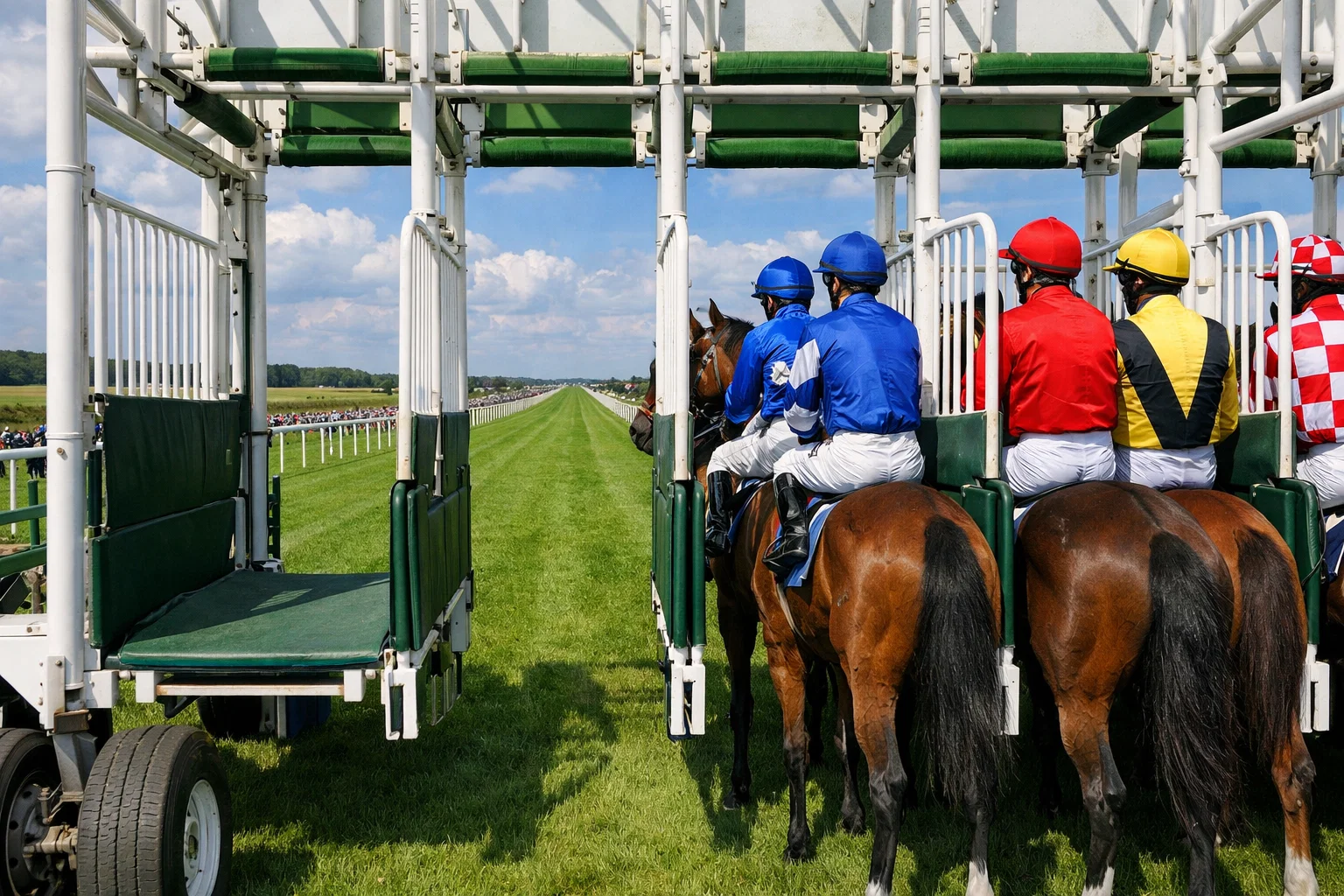
A common misconception is that when a horse is withdrawn, the stall numbers are reassigned. They are not. If Horse A was drawn in stall 3 and is withdrawn, stall 3 simply remains empty. The horses in stalls 1, 2, 4, 5 and so on keep their original positions. What changes is the distribution of runners across the track — the gap created by the empty stall can alter how the field groups in the early stages of the race.
This matters most at courses with pronounced draw biases. Chester, with its tight left-handed turns, consistently favours low draws in sprint races. If a non-runner was drawn in stall 1 or 2, the horse that was in stall 3 suddenly becomes the lowest-drawn runner — a tangible advantage at that course. At Beverley, high draws tend to be favoured over five furlongs. A non-runner from a high stall changes the competitive picture for the remaining high-drawn runners.
At Goodwood, the undulations and camber of the track create draw biases that vary depending on the going and the field size. A non-runner in a big-field handicap at the Glorious meeting might barely register. A non-runner in a ten-runner Group race could shift the balance significantly if the withdrawn horse was drawn on the favoured side of the track.
The draw impact of a non-runner is most pronounced in sprints and short-distance handicaps, where the stall position relative to the rail or the favoured ground matters from the moment the gates open. In longer races — mile and a quarter and beyond — the draw’s influence diminishes because horses have more time to find their position, and the impact of one empty stall is diluted over a longer run to the first bend.
For punters, the takeaway is to reassess the draw after every non-runner is declared, not before. Many punters do their draw analysis on the basis of the declared field and never revisit it after a withdrawal. That is a mistake, particularly at courses where draw bias is strong and well-documented. The data is available — course statistics broken down by stall position are published by most racing data providers — and cross-referencing it with the revised field after a non-runner takes no more than a few minutes.
When the Pace-Maker Is Withdrawn: Reading the New Race Shape
Pace is one of the most underanalysed factors in horse racing, and it is one of the areas most affected by non-runners. The withdrawal of a single horse can fundamentally alter the tactical shape of a race — turning a strongly run contest into a tactical crawl, or vice versa.
The most dramatic scenario is the loss of the likely front-runner. Every race has a pace profile: some horses want to lead, some want to sit just behind the pace, and some want to be held up at the back for a late run. When the horse most likely to lead is withdrawn, the remaining field has to answer a question: who takes it on now? If no other runner has a strong front-running profile, the early pace drops, the race becomes tactical, and horses who thrive in strongly run races — the closers and the hold-up performers — may find themselves disadvantaged by the slower tempo.
The reverse can also happen. If a confirmed hold-up horse is withdrawn, and the remaining field is dominated by front-runners and prominent racers, the pace may be hotter than anticipated. With multiple horses vying for the lead and no one willing to drop back, the tempo increases, and the race favours horses with stamina and those who settle well off the pace.
Then there is the pacemaker. In Group and Graded races, it is common practice for a trainer to enter a pacemaker — a horse whose sole job is to ensure a genuine gallop for its more fancied stable companion. If the pacemaker is withdrawn, the fancied horse loses its tactical support. This is particularly relevant in middle-distance and staying races where the pace of the early stages determines the complexion of the finish. Without its pacemaker, a front-running horse may have to do its own donkey work, expending energy on making the pace that it would otherwise have conserved for the finish. Conversely, a hold-up horse whose pacemaker was set to guarantee a strong tempo may find itself in a slowly run race that does not play to its strengths.
Punters often focus on the fancied horse and overlook the pacemaker entirely. That is a mistake. When you see a trainer withdraw a secondary entry from a race where they also have a principal runner, consider how the withdrawal of that tactical tool changes the race for the horse that remains. The market may not fully account for this — pacemaker dynamics are understood by professionals but often ignored by the broader betting public.
For punters, the practical approach is to identify the pace profile of each runner before the race and then reassess after any withdrawal. Who was likely to lead? If that horse is now a non-runner, who takes over? If no one does, expect a slower race. If the hold-up horse is gone, expect a stronger pace. These are not certainties — horses and jockeys can surprise — but they are probabilities worth factoring into your selection.
Speed maps — visual representations of where each horse is expected to sit in the early stages — are becoming more common in racing media and data services. Building a simple speed map before the race and then revising it after each non-runner declaration takes no more than a couple of minutes and gives you a tactical view that most punters skip entirely. When the pace changes, the value shifts with it. A horse priced at 6/1 as a hold-up performer in a strongly run race becomes a different proposition entirely if the front-runner is withdrawn and the pace collapses.
The connection between pace and ground adds another dimension. On soft or heavy going, races are typically run at a slower tempo because the ground saps energy. If a front-runner is withdrawn on a day when the going is already testing, the remaining field may produce an exceptionally slow race — benefiting those who race prominently and punishing those who need a strong gallop to deliver their finishing kick. Conversely, losing a hold-up horse on fast ground, where the pace is likely to be honest anyway, may have minimal tactical impact.
Field Size After Withdrawals: When Small Gets Smaller
Non-runners do not just affect the tactical and market dimensions of a race — they affect its structure. When a field shrinks below certain thresholds, the betting rules themselves change.
The most immediate impact is on each-way terms. Bookmakers set the number of places paid based on the declared field size: typically four places for handicaps of sixteen or more runners, three places for fields of eight to fifteen, and two places for fields of five to seven. Below five declared runners, most bookmakers pay win only. A non-runner that drops the field from eight to seven does not just remove one horse — it removes a place from the each-way payout. That is a structural change that affects every each-way bet in the race.
The trend is heading in one direction. BHA modelling suggests that British racecourses could see six to seven per cent fewer runners by 2027 compared with 2024 levels. Tom Byrne, BHA Head of Racing and Betting, put it plainly in a February 2026 interview: “Our modelling at the moment is suggesting that by 2027, we’ll have probably between five and ten per cent fewer runners compared to 2024.” That trajectory means non-runners will hit proportionally harder in the years ahead — because the fields they are being withdrawn from are already smaller than they were a few years ago.
At the extreme end, a race can be voided entirely if the field drops below the minimum. A race with fewer than two runners cannot take place. In practice, bookmakers void all bets on a race that does not run, returning stakes in full. This is rare, but it happens — particularly at smaller National Hunt meetings in winter where fields are already marginal and a couple of going-related withdrawals can leave a race with only one confirmed runner.
Tricast bets require a minimum of three runners; forecasts require at least two. When non-runners drop the field below these thresholds, those bet types are voided automatically and stakes returned. If you have placed a tricast in a race that started with six runners and two are withdrawn, the tricast still stands — but the odds shift considerably because there are fewer possible combinations. Understanding these thresholds is essential for anyone who regularly bets forecasts or tricasts, particularly in Jump racing where field attrition between declaration and raceday is more common.
For punters, the message is to check revised each-way terms after every non-runner, especially in races that were close to a threshold. A sixteen-runner handicap that loses one runner and drops to fifteen still pays four places. But a race that started with eight runners and loses one now pays two places instead of three — and that changes the economics of every each-way bet in the field. The bookmaker will update the terms, but not always prominently. It is on you to notice.
Turning Non-Runner Information Into a Betting Edge
Non-runner data is public, free, and available to everyone. The edge comes not from having the information, but from using it better than the average punter — which, given how few people formally incorporate non-runner analysis into their process, is a lower bar than you might think.
The first habit is timing. Know when non-runners are likely to be declared and check at those windows. For races with 48-hour declarations, the field crystallises two days before the meeting. For overnight declarations, it is the morning before. On raceday itself, withdrawals can happen at any point up to the off. Setting a routine — checking declarations after the 10am deadline, monitoring the racecard through the afternoon — ensures you are working from current information rather than yesterday’s racecard.
The second habit is integrating non-runner data with other factors. A non-runner on its own tells you the field has shrunk. Combined with going data, it tells you why. Combined with draw statistics, it tells you which remaining runners benefit from the gap. Combined with pace analysis, it tells you how the race is likely to be run. The punters who cross-reference these factors are making better-informed decisions than those who simply reprice the market in their heads and carry on.
Trainer non-runner rates, published by the BHA, are another tool. If a trainer with a historically high withdrawal rate has entered multiple horses on a wet card, the probability of at least one non-runner from that yard is elevated. Monitoring these entries gives you an early indication of where the field might shrink — before the official withdrawal is announced and the market adjusts. This is not insider information; it is publicly available data that most punters never look at. The BHA makes trainer statistics available precisely so that the market can function more efficiently, and ignoring a free data source is a choice, not an inevitability.
The Gambling Commission’s participation data from 2025 showed that 7% of UK adults bet on horse racing during the April-to-July festival window, compared with 4% in the quieter January-to-April period. That seasonal surge means more casual bettors in the market during peak season — bettors who are less likely to adjust their positions after a non-runner. For those who do incorporate non-runner analysis, the information advantage is greatest precisely when the market is busiest and the casual money is flowing in.
Reading the Race After Every Withdrawal
The habit is simple: every time a non-runner is declared, reassess three things. First, the odds — has the market adjusted, and is there still value in your selection at the new price? Second, the draw — has the withdrawal shifted the positional advantage at this course, particularly in sprints where stall position is decisive? Third, the pace — has the likely front-runner or a key tactical horse been removed, and how does that change the expected tempo and shape of the race?
These three reassessments take less than a minute for a punter who has done their homework on the original field. They take no time at all for someone who has not. The difference between the two is the difference between reacting to non-runner information and ignoring it — and over the course of a season, that difference adds up in your balance.
A non-runner does not just remove a horse — it rewrites the race. The punters who recognise that and respond accordingly are the ones who consistently find themselves on the right side of the adjusted market. Non-runners are not noise. They are data. And in horse racing, data that everyone can see but few bother to act on is exactly the kind of edge that compounds quietly over time.