
Best Horse Racing Betting Sites – Bet on Horse Racing in 2026
Loading...
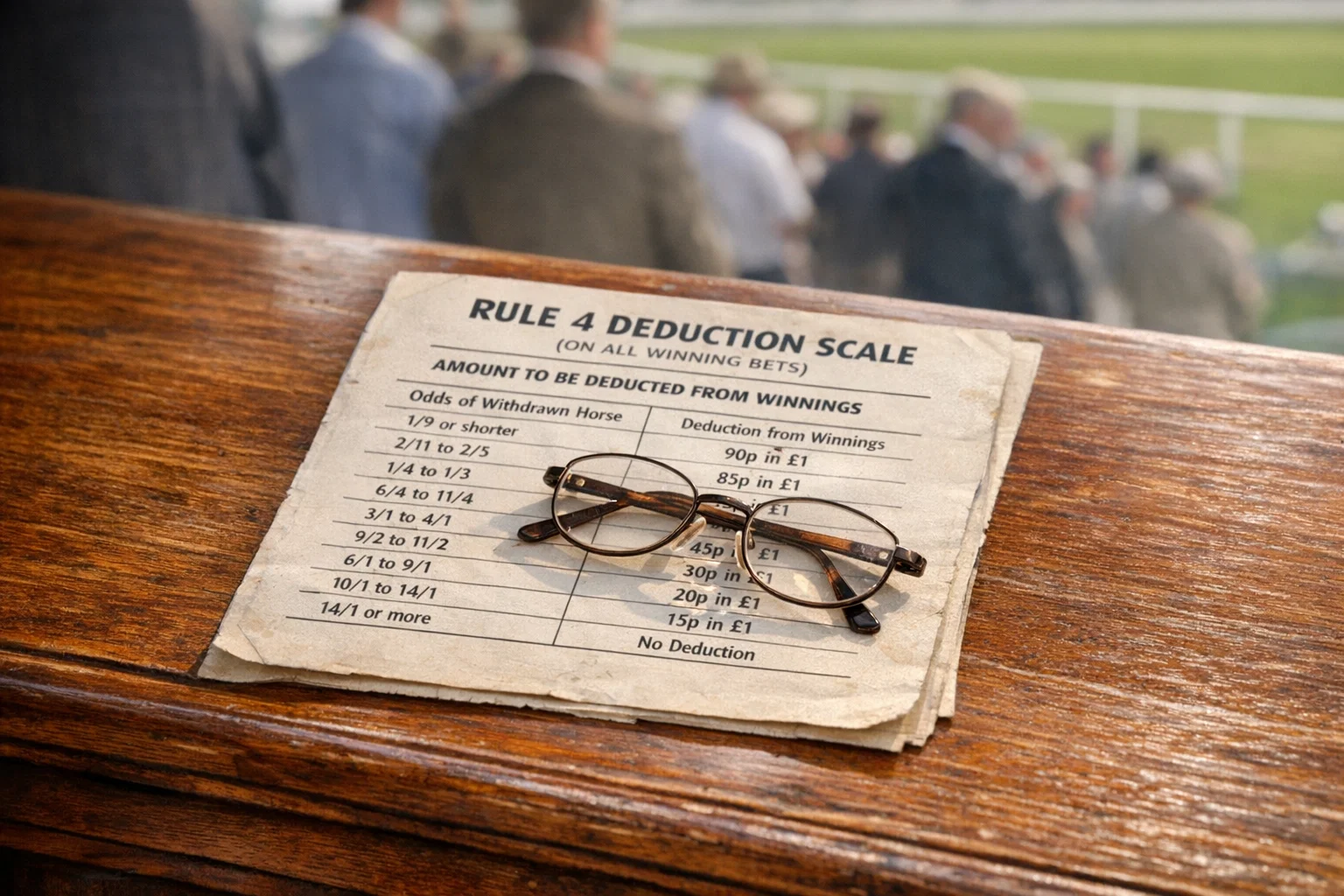
Every Rule 4 deduction starts with a table. When a horse is withdrawn from a race, the amount taken from your winnings isn’t arbitrary — it’s set by Tattersalls Rule 4(c), pegged to the starting price of the withdrawn horse. The shorter the price of the non-runner, the bigger the deduction. That’s the core logic, and the table below lays it out in full.
Knowing the table matters more now than it did a decade ago. As BHA Director of Racing Richard Wayman noted in 2025, total betting turnover on British racing fell nine per cent in the opening months of that year compared with the same period in 2024. When margins are tighter for everyone — punters and bookmakers alike — a deduction of 45p or 75p in the pound isn’t a rounding error. It’s the difference between a profitable afternoon and a flat one. The lower the price of the withdrawn horse, the bigger the bite from your winnings.
The Complete Tattersalls Rule 4(c) Deduction Table
The table below shows every price band under Tattersalls Rule 4(c). The left column is the starting price (or the last price before withdrawal) of the non-runner. The right column is the deduction applied to your winnings, expressed in pence per pound.
| Price of Withdrawn Horse | Deduction (pence in the pound) |
|---|---|
| 1/9 or shorter | 90p |
| 2/11 to 2/17 | 85p |
| 1/4 to 1/5 | 80p |
| 3/10 to 2/7 | 75p |
| 2/5 to 1/3 | 70p |
| 8/15 to 4/9 | 65p |
| 8/13 to 4/7 | 60p |
| 4/5 to 4/6 | 55p |
| 20/21 to 5/6 | 50p |
| Evens to 6/5 | 45p |
| 5/4 to 6/4 | 40p |
| 13/8 to 7/4 | 35p |
| 15/8 to 9/4 | 30p |
| 5/2 to 3/1 | 25p |
| 10/3 to 4/1 | 20p |
| 9/2 to 11/2 | 15p |
| 6/1 to 9/1 | 10p |
| 10/1 to 14/1 | 5p |
| Over 14/1 | No deduction |
A few things stand out immediately. The deductions are not linear — they jump in 5p increments, but the price bands they cover get wider as the odds lengthen. At the short end, a shift from 1/9 to 2/11 changes the deduction from 90p to 85p. At the long end, a horse priced anywhere from 10/1 to 14/1 triggers the same 5p deduction. Beyond 14/1, there’s no deduction at all. The logic is simple: a short-priced horse is expected to be more competitive, so its removal distorts the race more significantly.
The practical sweet spot — the range where most deductions actually land — is between evens and 4/1. This is where the majority of market leaders are priced in standard races. A non-runner at 2/1 triggers a 30p deduction; one at evens costs 45p. That’s a meaningful chunk of your returns, especially if you’ve backed a short-priced winner and were counting on a modest but reliable profit.
The maximum cumulative deduction, even when multiple horses are withdrawn from the same race, is capped at 90p in the pound. This cap is specified under Tattersalls Rule 4(c) and applies across all licensed bookmakers in Britain as well as on the Betfair Sportsbook. If three horses are pulled out and the individual deductions would add up to more than 90p, the total is still capped at 90p. You will never lose more than 90% of your winnings to Rule 4 deductions, no matter how many non-runners there are.
That said, a 90p deduction means you’re keeping only 10p per pound of your winnings. In a race where the two shortest-priced horses are both withdrawn, the remaining market is so distorted that your winning bet pays a fraction of its displayed price. This is rare — most races see either zero or one non-runner — but at big festivals with deep fields and short-priced market leaders, it’s a scenario worth keeping in mind.
How to Read the Table: Price, Deduction, and What You Keep
Reading the table is straightforward once you understand what you’re looking at. The price in the left column is the starting price (SP) or, if the horse was withdrawn before the off, the last traded price or the price at the time of withdrawal. This is the price of the withdrawn horse, not the price of your horse. That distinction trips up more punters than any other aspect of Rule 4.
Say you’ve backed a horse at 5/1 and it wins. A different horse in the race was withdrawn at a price of 3/1. You look up 3/1 in the table and find a deduction of 25p in the pound. That 25p comes off your winnings — not your stake. On a £10 bet at 5/1, your gross winnings would be £50. The 25p deduction takes £12.50 off that (25% of £50), so you receive £37.50 in winnings plus your £10 stake back, totalling £47.50 instead of £60.
If the withdrawn horse was a long-priced outsider — say 12/1 — the deduction drops to just 5p in the pound. On the same £10 bet at 5/1, you’d lose only £2.50 from your winnings. The impact is small because the withdrawal of a 12/1 shot barely shifts the competitive balance of the race.
If the withdrawn horse was priced above 14/1, there’s no deduction at all. The market considered the horse so unlikely to win that its removal has negligible impact on the other runners’ chances. This is a common outcome in large-field handicaps where several runners might be priced at 20/1 or longer.
It’s worth noting that on the Betfair Exchange, the mechanism is different. Instead of Rule 4, Betfair applies a reduction factor based on the horse’s implied probability of winning. If the reduction factor is below 2.5%, no adjustment is applied — the exchange treats the horse as a non-material runner whose withdrawal doesn’t meaningfully alter the market. The reduction factor is recalculated and frozen approximately fifteen minutes before the off. This means the timing of a withdrawal matters more on the exchange than with a traditional bookmaker, where Rule 4 deductions follow the table regardless of when the horse was pulled out.
For each-way bets, Rule 4 applies to both the win and the place portions of the bet. If your horse finishes in a place position and the deduction is 20p, that 20p is taken from both the win calculation (if applicable) and the place calculation. This can feel like a double hit, but it’s consistent with the principle: the removal of a short-priced runner changes the place market just as it changes the win market.
Bookmark This Table for Raceday
The Rule 4 table isn’t something you need to memorise, but it is something you should have to hand on a raceday. The key principle is simple: the lower the price of the withdrawn horse, the bigger the bite from your winnings. A favourite going out will cost you. An outsider going out barely registers. And if the cumulative deductions from multiple withdrawals climb past 90p, the cap kicks in — small comfort, perhaps, but a cap nonetheless.
Save this table, screenshot it, bookmark it. When a non-runner is announced ten minutes before the off and you want to know what it does to your potential payout, this is where the answer lives.