
 Available in US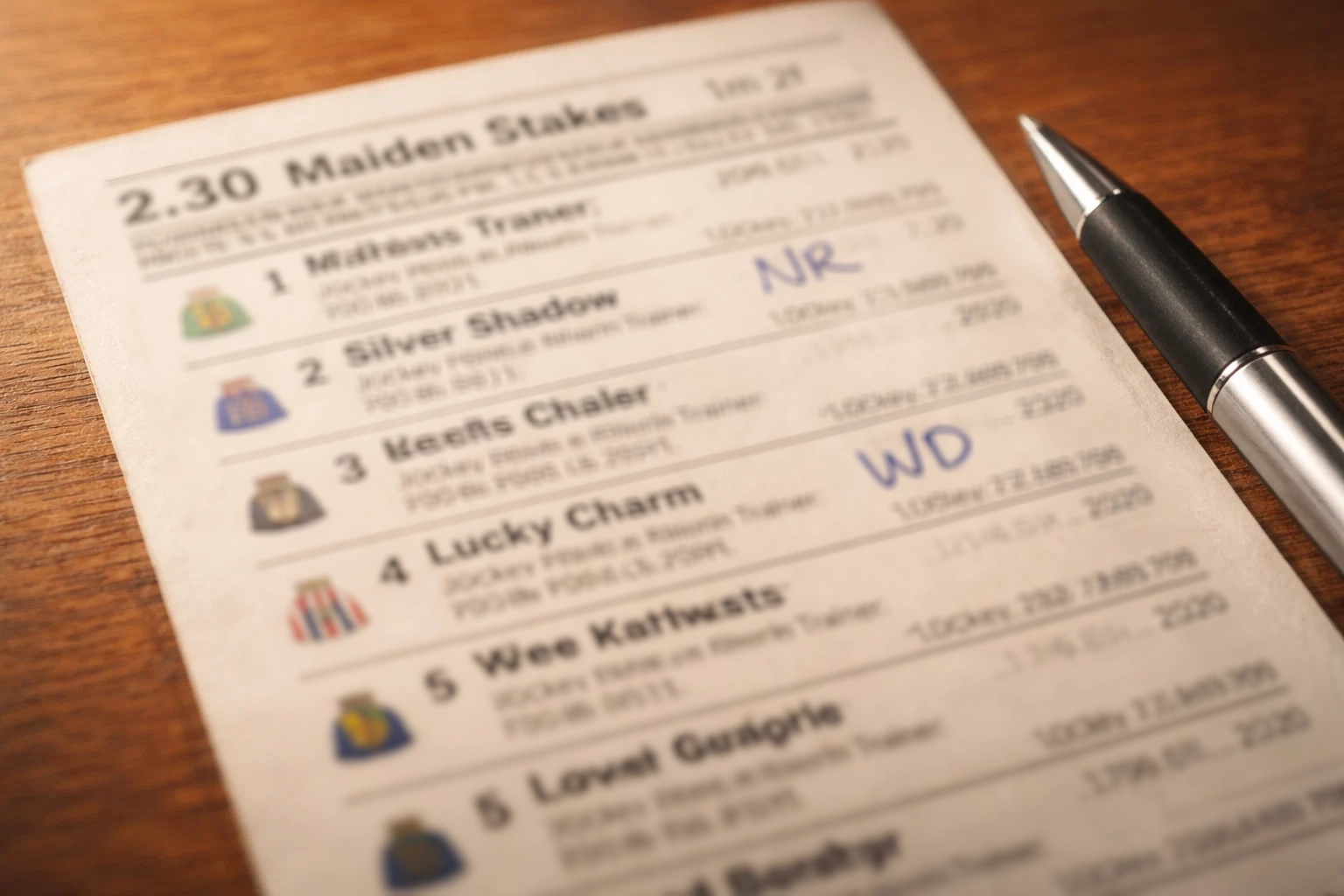
Racing has a language problem. Not in the sense that it’s hard to understand — though it can be — but in the sense that different jurisdictions use different words for the same thing, and sometimes the same word for different things. Non-runner, withdrawn, scratched, pulled out, taken out, didn’t run. If you’ve ever tried to figure out why some results pages show “NR” and others show “WD,” or why an American racing fan uses “scratched” where a British one says “non-runner,” you’ve bumped into this problem head-on.
The label on the racecard determines what happens to your money. That’s not an exaggeration. Whether a horse is recorded as a non-runner, a withdrawal, or a non-finisher changes the settlement of your bet, the applicability of Rule 4 deductions, and whether you have any right to a refund. Getting the terminology wrong won’t cost you the price of a dictionary — it could cost you the price of a bet.
See also Rule 4 Deduction Table.
Every Term Explained: NR, Withdrawn, Scratched, Non-Finisher
Non-Runner (NR) is the standard UK term for a horse that was entered and declared for a race but does not take part. It covers every withdrawal that happens before the race begins — whether the trainer pulled the horse out at the 48-hour declaration stage, or the horse was removed at the course an hour before the off. In British racing, NR is the official designation used by the BHA and displayed on racecards, results pages, and the Racing Admin System operated by Weatherbys. When you see “NR” next to a horse’s name, it means the horse was declared to run, then removed from the field before the start. For betting purposes, a non-runner on a day-of-race market triggers a full stake refund on that selection, and Rule 4 deductions may apply to the remaining runners.
Withdrawn (WD) is essentially a synonym for non-runner in everyday UK usage, but there’s a subtle distinction in how racing professionals sometimes deploy it. “Withdrawn” tends to be used when referring to the act of removal — “the trainer withdrew the horse” — while “non-runner” describes the horse’s status on the racecard after the decision has been made. In practice, you’ll see both terms used interchangeably in media coverage and on betting sites. Some platforms mark a horse as “W” or “WD” rather than “NR,” particularly in historical results, but the settlement rules are identical. If a racecard says withdrawn and it happened before the off, your bet is treated the same as if it said non-runner.
There is one context where “withdrawn” carries a more specific meaning: when stewards or officials remove a horse at the start. If a horse is unruly, refuses to enter the starting stalls, or is deemed unfit to race by the veterinary officer at the course, the official decision is typically recorded as a withdrawal by the stewards. The practical effect on your bet is the same — stake returned, Rule 4 applied — but the route to that outcome involves the racecourse officials rather than the trainer.
Scratched is the term you’ll hear most often in North American racing — and to a lesser extent in Australian and French racing — for what the British call a non-runner. In the United States, when a horse is removed from a race before the start, it’s scratched. The word has no official status in the BHA Rules of Racing, but it appears frequently in international coverage and on global betting platforms that serve multiple jurisdictions. If you’re reading about a scratching at Churchill Downs, it’s the same event as a non-runner at Cheltenham — different word, same outcome. Some UK-facing platforms that also cover international racing use “scratched” alongside “NR” depending on the jurisdiction of the race, which can add to the confusion.
Non-Finisher sits on the other side of a critical dividing line. A non-finisher is a horse that started the race but did not complete it — it fell, was pulled up by the jockey, unseated its rider, or refused at a fence. The key distinction is timing: a non-runner never started; a non-finisher did start but didn’t finish. This is not a semantic quibble. For betting purposes, a non-finisher is a loser. Your bet stands, your horse lost, and there is no refund. The horse was under starter’s orders, it participated in the race, and the fact that it didn’t cross the finish line doesn’t entitle you to your money back. This catches out plenty of casual bettors on Jump racing, where falls and pull-ups are common.
Refused to Start / Left in Stalls occupies a grey area that used to cause significant headaches. If a horse was loaded into the starting stalls but failed to break cleanly — perhaps the stall didn’t open, or the horse reared and was left behind — the traditional classification was murky. Was it a runner who didn’t finish, or was it effectively denied a start? Since May 2024, the BHA’s fair start rule has empowered stewards to declare a horse a non-runner retrospectively if it was denied a fair start due to circumstances beyond its own or its rider’s control. This provision was extended to tape-start Jump races from October 2025, closing a gap that had frustrated punters for years.
When Does Each Status Apply? UK vs North American Usage
The terminology differences between the UK and North America aren’t just cosmetic — they reflect different regulatory architectures. In the UK, the BHA governs all non-runner declarations through a centralised system. Trainers notify Weatherbys, the information flows into the Racing Admin System, and the status is updated on racecards and betting platforms simultaneously. The language is standardised: NR for horses that don’t start, non-finisher for horses that start but don’t complete. Simple, if you know where to look.
In North American racing, the system is decentralised. Each state racing commission sets its own rules. A scratching in California might follow a slightly different process than a scratching in New York. The term “scratched” covers both what the UK would call a pre-race non-runner and some late withdrawals at the gate. There’s no direct equivalent of the UK’s Rule 4 deduction system on most American tracks — instead, the tote pool is simply recalculated to exclude the scratched horse, and any bets on that horse are refunded. This is a cleaner system in some ways, but it only works because American racing is predominantly pari-mutuel rather than fixed-odds.
Australia sits somewhere between the two. The term “scratching” is standard, and the process is governed by Racing Australia’s Rules of Racing. Australian scratching rates tend to be lower than British non-runner rates, partly because of different ground conditions and partly because of tighter regulatory requirements around late withdrawals. The fair start rule that the BHA introduced in 2024 was modelled on an IFHA framework that had already been adopted in several Australian states — a rare case of British racing following the Australian lead rather than the other way around.
Ireland, being so closely linked to British racing, uses the same terminology and largely the same rules. A non-runner at Leopardstown is declared and settled in the same way as one at Newbury. The Horse Racing Ireland regulations mirror BHA rules on most points, including Rule 4 deductions and the treatment of ante-post bets. Cross-border runners are common, trainers are often licensed in both jurisdictions, and the betting markets treat the two as essentially one ecosystem.
The fair start rule introduced by the BHA has been used approximately half a dozen times since its launch for stalls races in May 2024. That low frequency reflects the rule’s intent: it’s a safety net for exceptional circumstances, not a routine mechanism. But its existence created a new category within the terminology — a horse can now be declared a non-runner after the race has started, something that was previously impossible under BHA rules. For bettors following international racing, this is a significant conceptual shift. The dividing line between “runner” and “non-runner” is no longer fixed at the moment the stalls open; it can be redrawn retrospectively by the stewards.
Why the Label Matters for Your Bet
Terminology matters because settlement follows terminology. If the racecard says NR, your day-of-race bet is void and your stake comes back. If it says non-finisher, your bet is a loser — no matter how unfairly you feel your horse was treated by the track, the weather, or the horse in front. The new fair start rule blurs this line slightly, but only in specific, steward-determined circumstances.
When you’re reading racecards from different countries or using platforms that cover multiple jurisdictions, pay attention to the label. A scratching in America is a non-runner in Britain. A withdrawal at the start is handled differently now than it was before 2024. The label on the racecard determines what happens to your money — and knowing which label applies is the first step to understanding where your stake ends up.
Non-Runner vs Withdrawn vs Scratched — More on this topic at horse racing non runners.
