 Available in US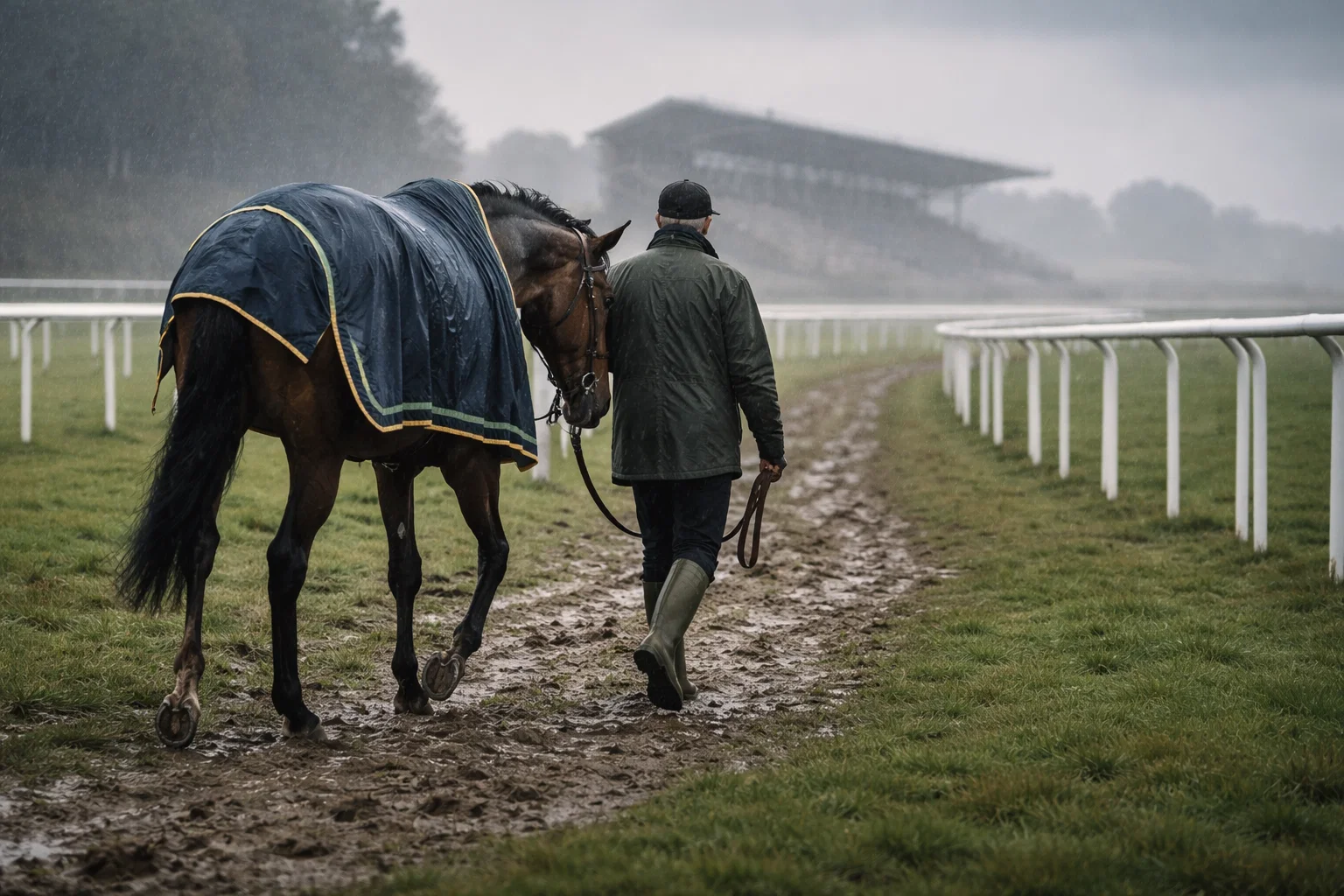
- Ground Conditions: The Biggest Driver of Withdrawals
- How a Going Change Triggers a Wave of Non-Runners
- Trainer Judgement: Protecting the Horse's Career
- Injury, Illness & Veterinary Withdrawals
- Transport, Weather & Logistical Non-Runners
- Stalls Refusals, Temperament & Behavioural Withdrawals
- Spotting the Pattern: What Withdrawal Reasons Tell You
A horse can be entered for a race weeks in advance and still never make it to the start. The reasons for non-runners in horse racing range from the mundane — a change in the weather overnight — to the dramatic: a stable illness that wipes out an entire yard’s festival campaign in the space of forty-eight hours. Understanding why horses are withdrawn is not just academic curiosity. Every withdrawal has a reason, and the reason tells you something about the race that remains.
For punters, the cause matters as much as the fact. A horse withdrawn because the ground turned soft carries a different signal than one pulled out with a minor injury. The first tells you the going has changed and other ground-sensitive runners may underperform. The second tells you nothing about the remaining field. Reading the withdrawal reason — and knowing what it implies — is one of the quieter edges available to anyone willing to look beyond the racecard.
This guide catalogues every significant reason behind non-runners in UK racing, from ground conditions and trainer strategy to veterinary interventions, transport failures, and behavioural issues at the start. Each category carries its own patterns, its own frequency, and its own implications for the race it leaves behind.
See also How Non-Runners Are Declared.
Ground Conditions: The Biggest Driver of Withdrawals
If you had to name a single factor responsible for more non-runners than any other in British racing, it would be ground conditions. The going — the state of the racing surface — dictates whether a horse will run, and trainers monitor it obsessively from the moment entries close.
The UK going scale runs from Hard at one extreme through Firm, Good to Firm, Good, Good to Soft, Soft, and Heavy at the other. Each horse has preferences, sometimes strong ones, shaped by breeding, conformation, and past performance. A horse bred for fast ground — light-framed, long-striding, often a Flat sprinter — will struggle on Heavy. A mudlark who thrives in winter slop may be wasted on Firm. When the going does not suit, a trainer’s first instinct is often to wait for another day rather than risk injury or a demoralising defeat.
The numbers confirm the scale of this effect. According to BHA’s November 2024 Racing Report, 78% of Jump fixtures in the first three months of 2024 took place on soft or heavy ground — compared with a three-year average of 48%. That extraordinary skew was driven by a wet winter that waterlogged courses across the country, and it produced a corresponding spike in non-runners as trainers pulled horses who could not cope with the conditions.
The relationship between going and withdrawals is not always linear. A shift from Good to Good to Soft might cost a race one or two runners — the most ground-sensitive entries. But a shift from Soft to Heavy can trigger a cascade, particularly in Jump racing where the demands on a horse’s legs and lungs intensify on deep ground. National Hunt trainers, who often manage older horses with existing wear, are particularly cautious about running on ground that could cause long-term damage.
For Flat racing, the dynamic is reversed in summer. Prolonged dry spells can produce Firm or even Hard ground, prompting withdrawals from horses who need some cut. Racecourses water their tracks to mitigate this, but watering is an imprecise science — one side of the course may ride differently from the other, and trainers who walked the course in the morning may make a different call from those who relied on the official going report alone.
The practical lesson for punters is straightforward: always check the going before you check the odds. If the ground has changed since declarations closed, the racecard you studied may already be out of date.
How a Going Change Triggers a Wave of Non-Runners
A going change does not produce one non-runner. It produces a wave. The mechanism is predictable: overnight rain falls, the clerk of the course walks the track at dawn, the going is updated from Good to Soft to Good or worse, and within an hour the first withdrawal notifications start appearing on the Racing Admin System. By mid-morning, the racecard looks different from the one published the evening before.
The chain reaction extends beyond the obvious. When one horse is withdrawn, the remaining field’s dynamics shift. If the withdrawn horse was the likely pace-maker, the expected tempo changes. If it was the favourite, the market reprices. Other trainers, seeing a shrinking field or an altered tactical picture, may reconsider their own runners — not because of the going, but because the going-triggered withdrawal has changed the race they thought they were entering.
This cascading effect is most visible at multi-day festivals. A wet first day at Cheltenham can produce a string of non-runners across several races, and trainers with entries later in the week start hedging. If the ground is not expected to dry out, they may withdraw early to preserve horses for better opportunities at other meetings. The festival card, so carefully assembled months in advance, can lose a dozen runners before the first race on Day Two.
For punters, the timing of the going change matters. An overnight shift gives you time to reassess before the first race. A change during the racing day — perhaps after heavy rain during the lunch break — is harder to react to. The runners for the final two or three races were declared based on different conditions, and late withdrawals may come through with little notice. Staying close to the live going updates, whether through the racecourse’s official feed or a bookmaker app, is not optional on days when the weather is unstable.
There is one more subtlety. The going report is an official assessment, but it is also a snapshot. Ground can change between the time the report is issued and the time the horses reach the start. Some trainers trust the report; others send a representative to walk the course and make an independent judgement. The ones who walk the course tend to make better withdrawal decisions — and their remaining runners tend to be better suited to the actual conditions.
Trainer Judgement: Protecting the Horse’s Career
Not every withdrawal is forced by circumstance. Many are deliberate, calculated decisions by trainers who judge that running a particular horse in a particular race is not in the animal’s best interest — or the yard’s long-term plan.
The modern trainer manages a portfolio of equine athletes. Each horse has a target race, a preferred set of conditions, and a career trajectory that extends beyond any single afternoon. Withdrawing a horse from a Tuesday handicap to preserve it for a Saturday feature is not evasion; it is asset management. The horse gets an extra week of preparation, avoids unnecessary mileage, and arrives at the more valuable contest fresher. The punter who backed it for Tuesday loses nothing if the withdrawal happens before the final market, but may lose an ante-post stake if the bet was placed under standard terms.
The BHA publishes non-runner rates by trainer, updated regularly — a transparency measure that allows both regulators and punters to identify patterns. According to the BHA’s Q3 2025 Racing Report, these trainer-level statistics are designed to flag yards with unusually high withdrawal rates, which could indicate anything from cautious management to more concerning practices. The data is publicly accessible and represents one of the few objective tools punters can use to assess how likely a particular trainer’s entry is to actually run.
The broader context shapes these decisions. The total number of horses in training in the UK stood at 21,728 in 2025 — a decline of 2.3% from the previous year, according to BHA’s 2025 Racing Report. That figure has been falling at roughly 1.5% annually since 2022. With fewer horses in the yard, each one becomes more valuable, and trainers are less willing to risk them in races where the conditions or competition do not suit. A smaller string means more careful selection, which means more non-runners.
Richard Wayman, the BHA’s Director of Racing, acknowledged this dynamic in BHA’s November 2024 Racing Report when he noted that the racing department had worked with racecourses to adjust the race programme and spread races across the year, aiming to support more competitive fields. The implication was clear: the current programme sometimes attracts declarations from horses whose connections have no real intention of running unless everything aligns. When it does not, the horse is withdrawn — and the field shrinks.
For punters, the takeaway is to treat a trainer’s entry as a statement of interest, not a guarantee of participation. Check the yard’s recent non-runner record. Look at whether the horse has been declared for multiple races in the same week — a sign that the trainer is keeping options open and will choose the best opportunity closer to raceday.
Injury, Illness & Veterinary Withdrawals
Injury and illness are the most straightforward reasons for a non-runner, and often the most consequential. A horse that is not physically right cannot race safely, and the BHA’s Rules of Racing require that any horse withdrawn within 48 hours of a race on veterinary grounds must be accompanied by a veterinary certificate — Rule (F)97.2 — confirming the animal is unfit to compete.
The range of veterinary issues is broad. Minor setbacks — a slight heat in a tendon, a bruised foot after working on firm ground — can be enough to prompt a cautious trainer to pull a horse. More serious problems, such as respiratory infections, colic, or musculoskeletal injuries identified during a pre-race scope, lead to immediate withdrawal with no ambiguity.
Scoping — the practice of passing an endoscope through the horse’s airway to check for infection or bleeding — has become a standard part of pre-race preparation, particularly in National Hunt yards during winter. A horse that shows signs of mucus, inflammation, or exercise-induced pulmonary haemorrhage on the scope will not run. The scope result is often the final checkpoint before a trainer commits to racing, and it produces some of the most last-minute withdrawals in the sport.
The most dramatic illustration of illness-driven non-runners in recent years came at Cheltenham Festival 2024. Trainer Nicky Henderson was forced to withdraw seven or more horses from his Seven Barrows yard after an unidentified illness spread through the stable. The casualties included some of the most fancied runners at the meeting: Jonbon, Shishkin, and Constitution Hill. “I’m afraid we’ve had to make some very tough decisions,” Henderson said at the time, acknowledging that something was clearly affecting his horses across the board — a statement that underlined how rapidly a stable illness can dismantle months of preparation.
Oddschecker estimated Henderson’s potential lost prize money at approximately £1.3 million. For ante-post punters who had backed those horses without Non-Runner No Bet protection, the financial impact was total — every stake was lost with no return.
Stable illness tends to cluster. When one horse in a yard falls sick, others stabled nearby are at risk. A single case can become a yard-wide outbreak within days, which is why multiple withdrawals from the same trainer on the same card are a red flag. If you see two horses from the same stable pulled from different races on the same day, the third entry from that yard should be treated with extreme caution.
Transport, Weather & Logistical Non-Runners
Logistical non-runners are the least glamorous category, but they happen more often than casual fans might assume. Horses travel to racecourses in lorries and horseboxes, sometimes covering hundreds of miles on Britain’s motorway network. When that network fails — an accident on the M5, flooding on the A303, a breakdown in the horsebox itself — the horse simply does not arrive in time.
Winter weather amplifies the problem. Freezing temperatures can make loading ramps treacherous. Heavy snow closes rural roads that connect training yards to the main route network. Even without extreme weather, an unusually long journey on a cold day can leave a horse stressed and dehydrated, prompting the trainer to withdraw on arrival rather than race an animal that has not travelled well.
Racecourse access can be an issue too. Some smaller tracks have limited road infrastructure, and a single lorry blocking the entrance can delay multiple runners. Ferry crossings for Irish-trained runners add another layer of uncertainty — rough seas, delayed sailings, and port congestion have all contributed to non-runners at British meetings where Irish raiders were expected to feature.
These logistical withdrawals are unpredictable by nature. You cannot model them the way you can model going-related non-runners. What you can do is note which races attract runners from distant yards or overseas, and factor in a slightly higher non-runner probability for those entries. A horse trained in Lambourn running at Musselburgh faces a longer, more complex journey than one stabled five miles from the track. That distance is not reflected in the odds, but it is reflected in the likelihood of a last-minute withdrawal.
Stalls Refusals, Temperament & Behavioural Withdrawals
Some horses do not want to race — or more precisely, they do not want to start. Stalls refusals account for a small but visible percentage of non-runners in Flat racing, and the consequences extend beyond a single missed race.
When a horse refuses to enter the starting stalls, the starter and handlers have a limited window to load it. If the horse persistently resists — rearing, planting, or turning away — the starter may declare it a non-runner rather than delay the race further. The stewards will note the refusal, and the horse may be required to pass a stalls test before being allowed to race from stalls again. Repeated offenders can face temporary bans from stall-start races, effectively limiting them to National Hunt events or the rare Flat races run from a tape or flag start.
The BHA introduced the fair start rule in May 2024 for stalls races, extending it to tape-start Jump races in October 2025. Under this provision, stewards can retrospectively declare a horse a non-runner if it was denied a fair start through circumstances beyond its control or its jockey’s — for instance, a stalls malfunction that left the horse trapped while the field departed. This rule change was designed to protect both horses and punters, ensuring that a mechanical failure does not cost a horse its race and a punter their stake.
Temperament issues go beyond the stalls. Some horses are difficult to saddle, others become agitated in the parade ring, and a few simply refuse to cooperate once they reach the racecourse. Trainers who know their horse has a temperamental streak will sometimes withdraw pre-emptively if the atmosphere at the course — a large crowd, loud music, an unfamiliar environment — is likely to trigger poor behaviour. Better to save the race for a quieter day than risk an incident.
For punters, behavioural non-runners carry a specific signal. A horse withdrawn for refusing the stalls is telling you something about its mental state that may persist into future entries. Check whether the horse has a history of stalls issues before backing it in its next race — the problem often recurs, and a horse that needs to pass a re-test may not be in the ideal frame of mind even if it does make it to the start.
Spotting the Pattern: What Withdrawal Reasons Tell You
Every withdrawal has a reason, and the reason tells you something about the race that remains. A going-related non-runner signals that conditions have shifted, and other ground-sensitive entries may underperform even if they choose to run. A veterinary withdrawal from a prominent yard raises questions about whether other horses from the same stable are affected. A behavioural withdrawal suggests an issue that may resurface next time.
The discipline of reading non-runner reasons is not complicated, but it requires attention. When a withdrawal is announced, find out why. The Racing Admin System, bookmaker feeds, and racing press typically report the reason alongside the non-runner notification. A two-second glance at that reason can reshape your assessment of the entire race — the pace, the market, the draw, and the relative chances of every horse still standing.
Trainers withdraw horses to protect them. The horses that remain are the ones whose connections believe they are fit, suited, and ready. That belief is not always correct, but it is a filter — and using it alongside the withdrawal reason gives you a clearer picture of the race than any racecard printed twelve hours earlier.
Why Horses Are Withdrawn — More on this topic at horse racing non runners.
