 Available in US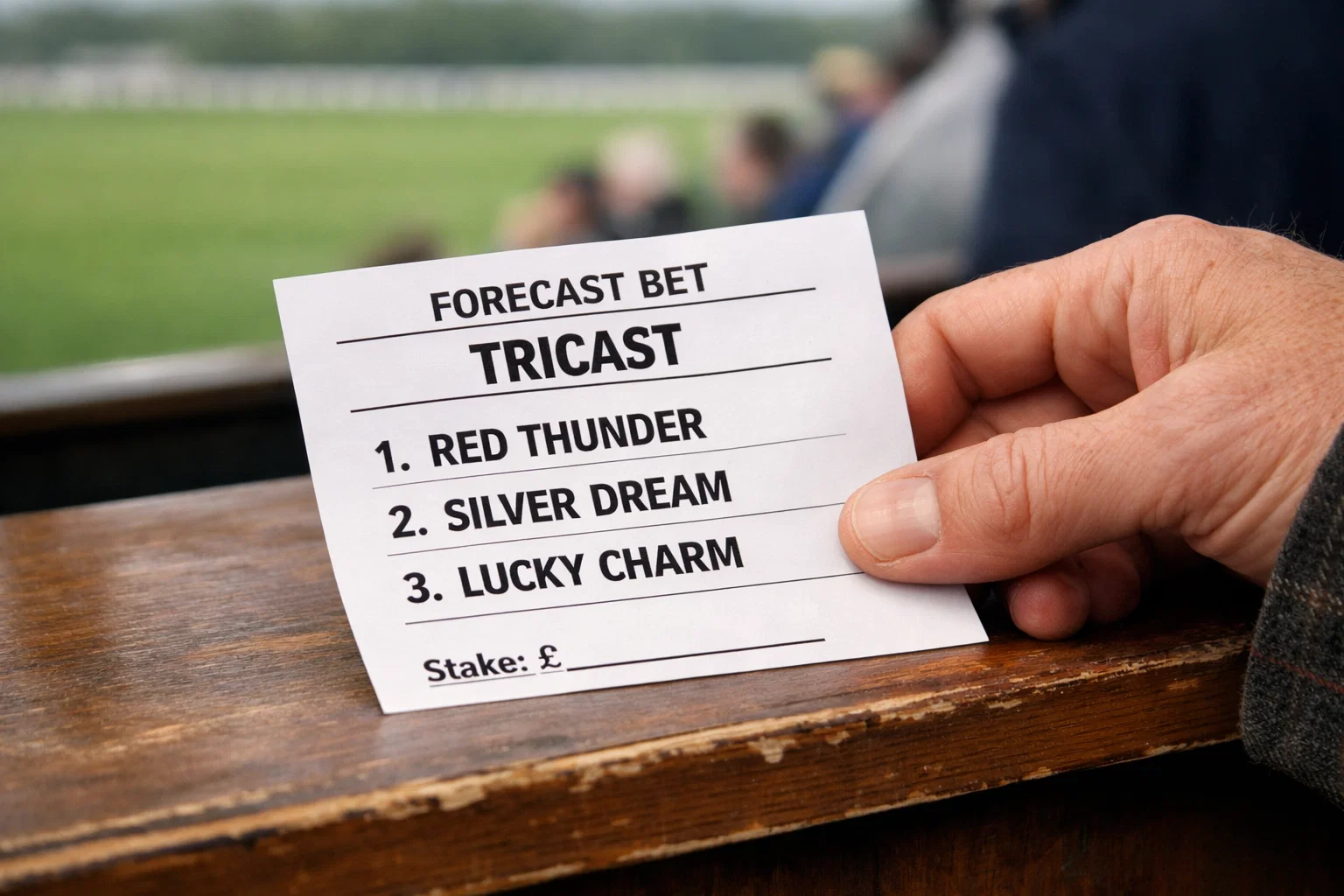
Forecast and tricast bets add a layer of complexity to non-runner rules that catches out even experienced punters. A standard single bet on a non-runner is simple — stake returned, done. But when your bet depends on predicting the first two or first three home, the withdrawal of one selection triggers a chain of consequences that varies by bet type, field size, and the specific bookmaker’s rules. Forecasts need at least two — tricasts need three — and non-runners count against you.
These bet types are niche but popular, particularly in big-field handicaps where the potential payouts are large and the challenge of predicting the exact finishing order adds an element of puzzle-solving. Understanding what happens when a non-runner disrupts your forecast or tricast is essential if you place these bets regularly — and the declining field sizes across British racing make the issue more relevant with each passing season.
Non-Runners in Forecast and Tricast Bets — More on this topic at horse racing non runners.
Non-Runner in a Forecast: What Happens
A forecast bet requires you to predict the first and second horses in the correct order. When one of your two selections is declared a non-runner, the bet is void and your stake is returned. There’s no halfway settlement — you can’t be paid out on the remaining selection as a single, because a forecast by definition requires two horses in order.
If neither of your forecast selections is a non-runner but another horse in the race is withdrawn, your bet stands unchanged. The maximum cumulative Rule 4 deduction of 90p in the pound applies to forecast payouts just as it does to win bets, but in practice this is rare in forecasts because the payout mechanism is different. Computer Straight Forecasts (CSFs) are calculated from the tote pool or a formula based on the starting prices, and the non-runner’s removal is already reflected in the recalculated pool or the revised SP structure.
The critical question for forecasts is whether the race still has enough runners to proceed as a forecast event. Most bookmakers require a minimum of three runners for a forecast bet to stand. If non-runners reduce the field below three, all forecast bets are void — regardless of whether your specific selections were withdrawn. In a field of four where two horses are withdrawn, leaving just your two forecast selections, the bet is typically void because the minimum threshold hasn’t been met.
This threshold effect creates a vulnerability in small-field races. In a seven-runner Grade 1, two non-runners drop the field to five — still comfortably above the forecast threshold. But in a five-runner race where two are withdrawn, you’re at three — the bare minimum, and another withdrawal would void everything. Forecasts are inherently bets on field size as well as form.
Non-Runner in a Tricast: The Minimum-Runners Problem
Tricasts — predicting the first three in exact order — face an even tighter constraint. Most bookmakers require a minimum of eight runners for a tricast bet to be offered, and some set the threshold even higher. When non-runners reduce the field below this minimum, all tricast bets are void and stakes returned.
With average Jump field sizes at 7.84 runners per race in 2025, according to the BHA’s 2025 Racing Report, many Jump races are already borderline for tricast eligibility before a single non-runner is announced. A Flat average of 8.90 is more comfortable, but still means that a couple of withdrawals from a standard-sized field can push it below the tricast threshold. Tom Byrne, the BHA’s head of racing and betting, has noted that modelling suggests five to ten per cent fewer runners by 2027 compared with 2024 — a trend that will make the tricast minimum-runners problem progressively more acute.
If one of your three tricast selections is a non-runner, the bet is void. Unlike accumulators, where a void leg converts the bet to a smaller multiple, a tricast with a missing leg has no fallback — it simply ceases to exist. You can’t be paid a forecast (first and second) from a tricast bet that’s lost its third selection. The bet type is specific, and if the specification can’t be met, the bet is cancelled.
The timing of the non-runner relative to the race is important. If a horse is withdrawn early enough — say, at the 48-hour declaration stage — the field size adjusts before tricast bets would typically be placed. But raceday non-runners, announced an hour or two before the off, can void tricast bets that were placed in good faith on a field that met the minimum threshold at the time of betting. This is frustrating but consistent: the rules are applied based on the field at the time of the race, not the field at the time the bet was placed.
CSF, Reverse Forecasts and Computer Tricasts
The different flavours of forecast and tricast betting each interact with non-runners in slightly different ways.
A Computer Straight Forecast (CSF) is the most common forecast type. The payout is calculated by a formula based on the starting prices of the first and second, rather than being a fixed-odds bet. Because the CSF is computed from the final market, the removal of a non-runner is already reflected in the starting prices of the remaining runners — so there’s no separate Rule 4 adjustment. The CSF simply produces a payout based on the field that actually ran.
A Reverse Forecast covers both finishing orders — your two selections finishing first-second and second-first. It’s effectively two CSF bets in one. If one of your selections is a non-runner, both halves are void. If the field drops below the minimum, the entire bet is void. The reverse forecast doesn’t offer any additional non-runner protection compared to a straight forecast; it just doubles the exposure to the same field-size risk.
Computer Tricasts work similarly to CSFs but for the first three. The payout formula accounts for the actual field that ran, so non-runners that don’t involve your selections are handled through the recalculated odds rather than through a separate deduction. The minimum-field-size requirement is the main vulnerability: if non-runners push the field below the threshold, the computer tricast is void regardless of which horses were withdrawn.
Named forecasts and tricasts — where you place a fixed-odds bet with a bookmaker on a specific combination at quoted prices — are subject to standard Rule 4 deductions. If a non-runner doesn’t involve your selections and the field remains above the minimum, your bet stands but the payout may be reduced by Rule 4 if the withdrawn horse was short-priced. This is one of the few scenarios where Rule 4 explicitly applies to forecast-type bets.
Forecasts and Tricasts Need Bigger Fields — Check Before Betting
The declining trend in field sizes across British racing makes forecast and tricast betting progressively riskier from a non-runner perspective. Every withdrawal brings the field closer to the void threshold, and in smaller-field races, a single non-runner can cancel your bet entirely. Forecasts need at least two — tricasts need three — and non-runners count against you. Before placing any forecast or tricast, check the declared field size and assess how many non-runners the race can absorb before your bet type becomes ineligible. The maths is simple; the habit of checking is what separates careful punters from frustrated ones.
See also Horse Population Decline and Its Effect on Non-Runners.
