
 Available in US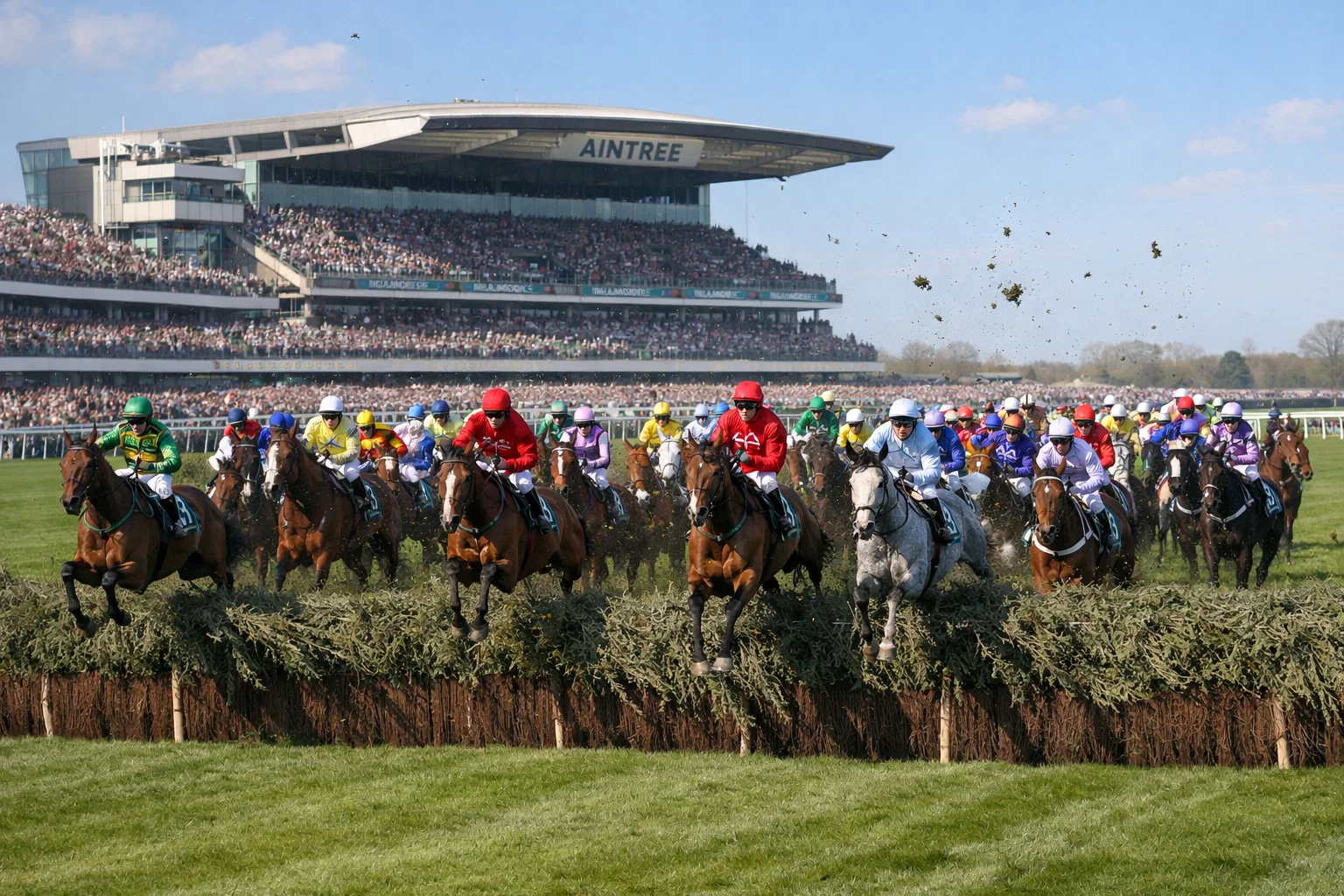
No race in Britain carries as much public attention as the Grand National, and no race has a more complex non-runner framework. The National’s unique combination of a large field, extreme distance, testing fences, and massive betting interest has produced a set of rules that exist nowhere else in the calendar. The Grand National has its own playbook — and non-runners are Chapter One.
Whether you’re a once-a-year punter backing a name from the newspaper or a serious form student who’s been tracking the weights since they were published, the non-runner rules at Aintree will affect your bet. Understanding the declaration timeline, the reserve system, and the field-size changes introduced in recent years is the starting point for any informed National wager.
Grand National Non-Runners — More on this topic at horse racing non runners.
What Makes Grand National Non-Runner Rules Different
The Grand National differs from every other race in Britain in several critical respects. The field is larger — up to 34 runners since the 2024 safety review. The declarations happen earlier — 72 hours before the race rather than the standard 48. The reserve system is deeper — six reserves rather than the usual handful. And the public and media scrutiny is more intense, which means non-runners generate headlines that lesser races don’t attract.
The size of the field creates a unique dynamic. In a 34-runner race, non-runners have a proportionally smaller impact on any individual horse’s chances than they would in a typical eight-runner novice chase. But the cumulative effect of multiple withdrawals can be significant, particularly when they cluster around the top of the handicap (where the best horses are concentrated) or involve horses that were expected to play a tactical role in the race — front-runners, for instance, or proven Aintree specialists whose presence shapes the pace and the jumping dynamics.
The handicapping dimension adds another layer. Every horse in the Grand National carries an assigned weight based on its official rating. When a horse at the top of the weights is withdrawn, the remaining field benefits slightly — not in terms of weight carried, which doesn’t change, but in terms of the competitive landscape. A high-rated horse’s removal means one fewer serious contender, which reshuffles the probabilities and, indirectly, the betting market.
For ante-post punters, the National’s rules create a prolonged period of vulnerability. Because the race is targeted months in advance by trainers and the ante-post market opens early in the season, the window during which your horse might be withdrawn spans the entire winter. Injury, illness, form setbacks, and changes of plan all threaten an ante-post selection — and under standard terms, none of them triggers a refund.
72-Hour Declarations and the Six-Reserve System
For 2026, the Grand National operates on a 72-hour declaration system with six reserves — an expansion from the previous framework of 48-hour declarations and four reserves. The final field is confirmed on the Wednesday before the Saturday race, giving an extra day compared to the standard declaration timeline.
The 72-hour window serves multiple purposes. It gives the BHA and Aintree more time to assess conditions, manage logistics for the uniquely large field, and process any late withdrawals before the final racecard is published. It also gives punters an additional day of certainty — from Wednesday onward, the declared field is known and the market can price accordingly.
The six reserves exist specifically to maintain field quality when withdrawals occur between the declaration deadline and raceday. If a declared horse is withdrawn on Thursday, the first reserve is activated and takes its place. A Friday withdrawal activates the second reserve, and so on. The reserve system means that early withdrawals don’t simply shrink the field — they trigger replacements, keeping the race as competitive as possible.
Reserves are ranked by handicap rating and their position on the reserve list is published alongside the main field. A punter who has backed a declared horse isn’t affected by reserve activations — their horse is still running (or not). But the activation of a reserve does change the competitive picture: a fresh horse entering the field on Thursday or Friday may be under-priced relative to its ability, because the market hasn’t fully assessed it as a likely runner.
Reserve activation typically stops on the morning of the race, though the precise cut-off can vary. After that point, any further withdrawals simply reduce the field. This is when the standard non-runner rules apply: raceday withdrawals void bets and trigger Rule 4 deductions, while any ante-post bets on the withdrawn horse remain lost.
From 40 to 34: The 2024 Safety Review
In 2024, the maximum field size for the Grand National was reduced from 40 to 34 runners — the most significant structural change to the race in modern history. The reduction followed a comprehensive safety review aimed at improving horse welfare outcomes, and it was accompanied by modifications to the course itself, including alterations to several fences.
The impact on non-runners was immediate. In the 2024 running, two horses — Chambard and Run Wild Fred — were declared non-runners on the day of the race due to lameness, reducing the field to 32. In a 40-runner field, two withdrawals would have reduced the runners by 5%. In a 34-runner field, the same two withdrawals removed nearly 6% — a small but meaningful difference in a race where every runner’s presence affects the jumping dynamics and the pace.
The smaller maximum field also changes the reserve calculus. With 34 spots instead of 40, the entry cutoff is higher — horses with lower ratings that would previously have scraped into the field are now on the reserve list or excluded entirely. This means the reserves for the 2026 National are likely to be better-quality horses than reserves were under the old system, making their activation more competitively significant.
For punters, the field-size reduction means that each non-runner carries slightly more weight than it did before 2024. In a 34-runner field, the remaining horses’ individual chances increase more per withdrawal than they would in a 40-runner field. Rule 4 deductions, while still tied to the withdrawn horse’s price, affect a smaller pool of remaining runners. The National is still the biggest field in British racing, but the margin between a full field and a depleted one is narrower than it used to be.
The National’s Rules Are Unique — So Is Your Risk
No other race in Britain combines the Grand National’s field size, declaration timeline, reserve system, and level of public betting interest. The 72-hour declarations, six reserves, and reduced maximum field of 34 create a non-runner framework that requires its own analysis. The Grand National has its own playbook — and non-runners are Chapter One. Whether you’re betting ante-post or on the day, understanding these rules is the foundation for a bet that accounts for the risks unique to Aintree’s greatest race.
See also Royal Ascot Non-Runners.
