
 Available in US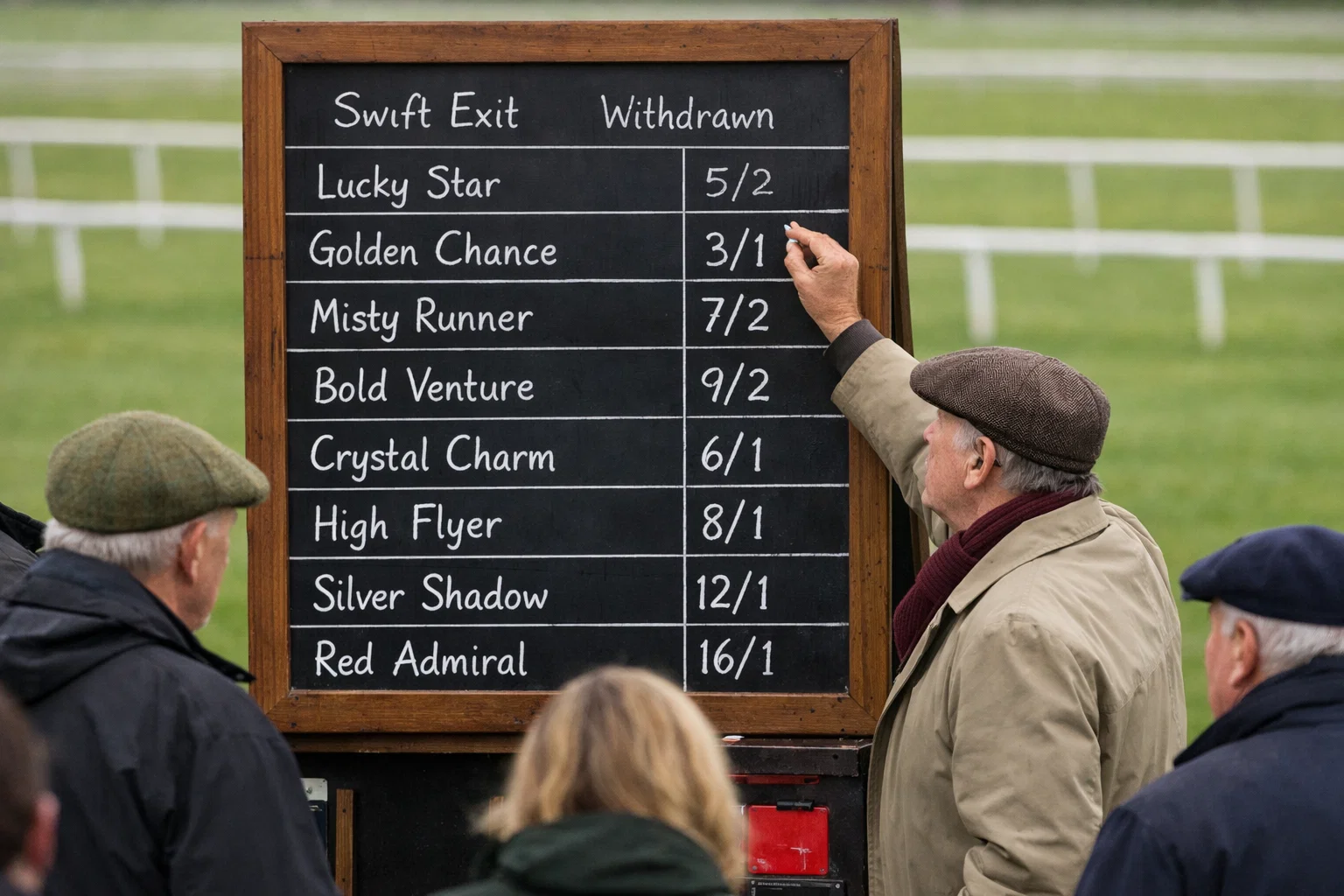
When a horse is withdrawn from a race, the market doesn’t just lose a runner — it reprices every remaining one. The adjustment happens fast, sometimes within minutes of the non-runner being announced, and the punter who understands what’s driving the repricing is better positioned than the one who simply watches the numbers change. The market reprices in minutes — you need to be faster.
The mechanics of how odds shift after a withdrawal involve two separate systems operating simultaneously: the Rule 4 deduction framework (which adjusts winnings on already-placed bets) and the live market adjustment (which changes the prices available for new bets). They serve different purposes, work on different timescales, and can produce different outcomes for the same non-runner event.
How Non-Runners Affect Odds — More on this topic at horse racing non runners.
The Immediate Market Reaction to a Non-Runner
The moment a non-runner is confirmed, the betting market begins to adjust. The removed horse’s implied probability — the share of the market it represented — has to be redistributed across the remaining runners. A horse priced at 4/1, for instance, holds roughly 20% of the market’s implied probability. When it’s withdrawn, that 20% doesn’t vanish; it’s absorbed by the remaining runners, whose prices shorten accordingly.
The redistribution isn’t equal. A horse that was the withdrawn runner’s closest market rival — similar price, similar form profile — tends to absorb the largest share. If the non-runner was a front-runner and there’s only one other front-runner in the field, that remaining pace horse’s odds will shorten more than those of the hold-up horses, because it directly benefits from the reduced competition at the front of the race.
The speed of the adjustment depends on the platform. On the Betfair Exchange, prices move in real time as bettors react to the news — the withdrawn horse’s odds go to maximum, and the remaining runners’ odds contract as money flows in. On bookmaker sites, odds compilers manually reprice the market, which can take anywhere from a few minutes to half an hour depending on the timing of the withdrawal and the bookmaker’s staffing.
This gap — between the exchange’s instant repricing and the bookmaker’s manual adjustment — creates a window of opportunity. In the minutes after a non-runner is announced, exchange prices may have already adjusted while some bookmaker sites still show the old prices. A punter who acts quickly can place a bookmaker bet at odds that are about to shorten, effectively capturing value from the lag. This window is small and getting smaller as bookmaker technology improves, but on busy racedays with multiple non-runners it still exists.
Rule 4 Settlement vs Live Market Adjustment
There’s a fundamental distinction between what happens to bets already placed and what happens to prices going forward.
Rule 4 deductions apply to bets placed before the withdrawal. If you backed a horse at 5/1 before the non-runner was announced, your winning return will be reduced by the appropriate Rule 4 deduction based on the withdrawn horse’s price. The deduction is fixed and mechanical — it follows the Tattersalls table, regardless of how the live market reacts.
Live market adjustment, by contrast, affects the prices available for bets placed after the withdrawal. The bookmaker reprices the remaining runners, and the new odds already reflect the removal. If you bet after the non-runner, you won’t face a Rule 4 deduction on that bet — but you’ll also be betting at shorter odds that account for the changed competitive balance.
On the Betfair Exchange, the mechanism is the reduction factor rather than Rule 4. The reduction factor is frozen approximately fifteen minutes before the off, and any withdrawal after the freeze uses the frozen percentages. This means late withdrawals on the exchange — those happening in the final minutes before a race — are adjusted based on prices that may no longer reflect the current market. For punters who bet on the exchange, the timing of the withdrawal relative to the freeze is an additional variable to consider.
In practical terms, the question is: should you bet before or after the non-runner is announced? If you have advance intelligence (from checking trainer NR rates, going forecasts, or morning market movements) that a withdrawal is likely, betting after the announcement at the adjusted price avoids Rule 4 entirely. If the withdrawal is unexpected and you already have a bet on, the Rule 4 deduction is unavoidable — but knowing the table in advance means you won’t be surprised by the settlement.
When the Favourite Is Withdrawn: Maximum Disruption
The most dramatic market moves follow the withdrawal of the favourite or joint-favourite. A horse priced at evens holds approximately 50% of the market’s implied probability. When it’s removed, that probability floods into the remaining runners, and prices across the board shorten significantly.
The Rule 4 deduction for an evens favourite is 45p in the pound — one of the steepest deductions on the table. Anyone who backed another horse before the withdrawal now faces a 45% reduction in their winnings. On exchange, the reduction factor would be roughly 50%, potentially even harsher than Rule 4 depending on the specific exchange prices.
Favourite withdrawals also trigger the most visible behavioural response in the market. The new favourite — whichever horse the market promotes to the head of the betting — often shortens beyond what the pure probability redistribution would suggest, because punters pile in on the perceived “obvious” replacement. This overreaction can create value in the second and third favourites, whose odds have shortened but not as dramatically as the new leader’s.
The impact is amplified in smaller fields. With Flat averages at 8.90 runners per race and Jump averages at 7.84, the withdrawal of the favourite from a field of eight is proportionally more disruptive than from a field of sixteen. In an eight-runner race, the favourite might hold 30-40% of the market. In a sixteen-runner handicap, even the favourite might hold only 15-20%. The same withdrawal, at the same price, carries different weight depending on how many runners remain to absorb the probability.
Speed Matters: React Before the Market Settles
The window between a non-runner announcement and the market reaching its new equilibrium is where value lives. The market reprices in minutes — you need to be faster. Check for non-runners as soon as they’re announced, assess the impact on your existing bets and any new opportunities, and act before the crowd has finished processing the same information. The adjustment is inevitable. The question is whether you’re ahead of it or behind it.
See also Cheltenham Festival Non-Runners.
