 Available in US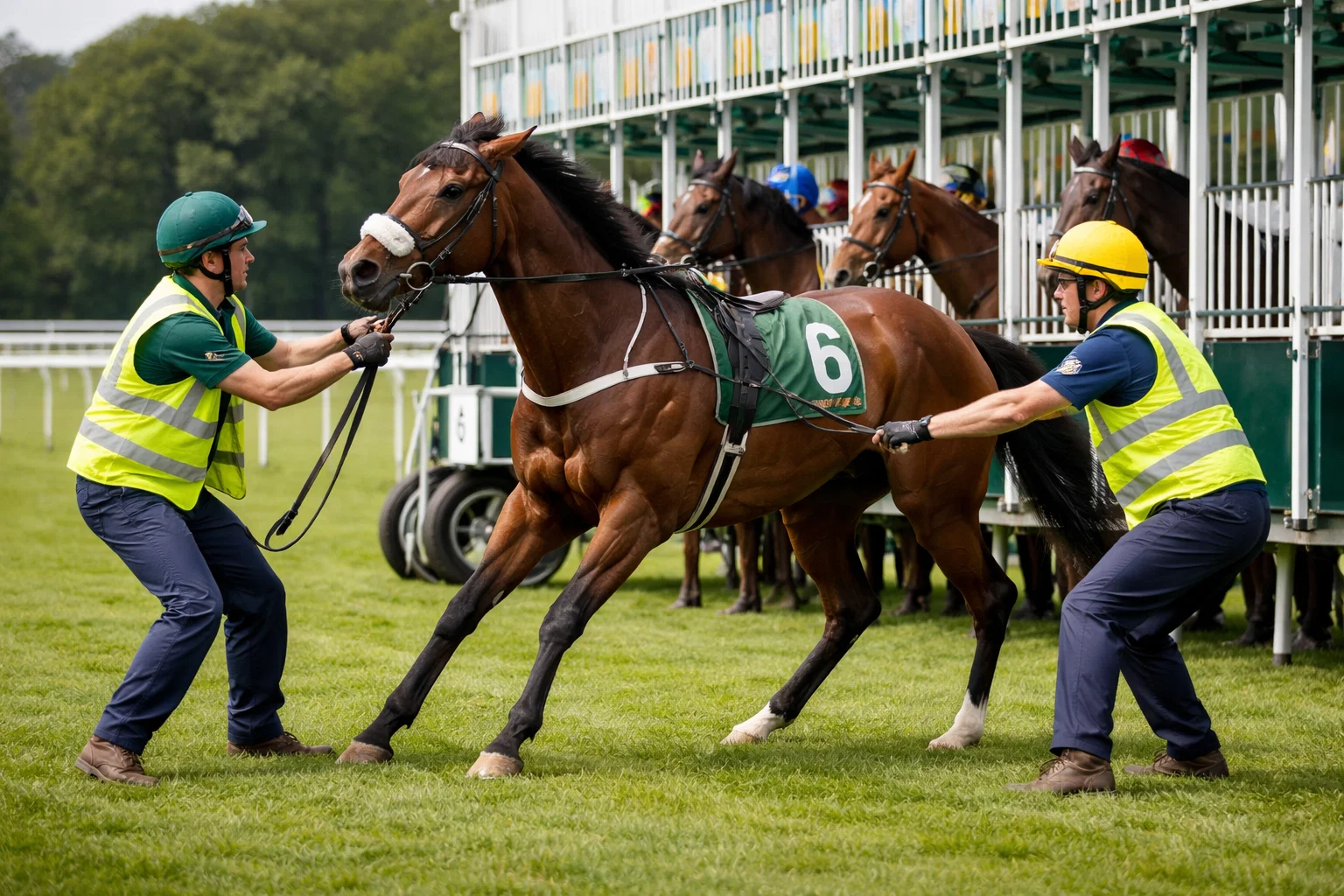
The starting stalls are waiting. The field is loaded, one by one, handlers guiding each horse into its compartment. Then one horse plants its feet. It won’t go in. The handler tries again. The horse rears, backs away, or simply refuses to move. The clock is ticking, the rest of the field is loaded and getting restless, and the stewards have a decision to make. The gate is the first obstacle — and not every horse clears it.
Stalls refusals are among the most visible and dramatic causes of non-runners in Flat racing. They happen in full view of the crowd, the cameras, and — most relevantly for punters — after the betting market has closed. What happens next depends on the nature of the refusal, the stewards’ assessment, and a set of BHA rules that carry consequences well beyond the immediate race.
What Happens When a Horse Refuses to Enter the Stalls? — More on this topic at horse racing non runners.
Refusal, Unruly Behaviour and Stalls Tests
Not every stalls incident is the same, and the BHA distinguishes between different categories of behaviour at the start.
A straightforward refusal is a horse that will not enter the stalls despite the efforts of the handlers. The horse may plant its feet, back away, or turn sideways. If the handlers and the starter determine that the horse cannot be loaded without unreasonable delay or risk to other runners, the stewards will withdraw it. The horse is declared a non-runner, bets are voided, and the race proceeds without it.
Unruly behaviour is a broader category. It covers horses that enter the stalls but become agitated — rearing, kicking, trying to climb out, or otherwise behaving in a way that endangers themselves, their jockey, or adjacent horses. A horse that goes into the stalls but then rears and gets cast (stuck on its back) is unruly rather than a refuser, but the outcome for betting purposes may be the same: withdrawal by the stewards.
Then there are stalls tests. A horse that has previously refused or been unruly at the stalls can be required by the BHA to pass a stalls test before it’s allowed to race again. The test is conducted at a racecourse or approved facility, supervised by an official, and assesses whether the horse will enter the stalls calmly and behave appropriately once loaded. Failing the test means the horse is banned from stalls-start races until it passes — effectively barring it from all Flat racing, since virtually all Flat races in Britain start from stalls.
The stalls test system exists because persistent refusers are a safety hazard and a disruption to the racing programme. A horse that refuses at one meeting and is allowed to run again without remediation is likely to refuse again, wasting everyone’s time and potentially causing injury. The testing requirement forces trainers to address the underlying issue — whether it’s a temperament problem, a handling issue, or a specific fear — before the horse returns to the racetrack.
For punters, stalls test history is relevant information. A horse that has previously been required to pass a stalls test has a documented history of problems at the start. While passing the test means it met the minimum standard, it doesn’t guarantee perfect behaviour under race conditions, where the pressure of a full field and the noise of a crowd can be very different from a quiet Tuesday morning at an empty course.
The Rules: Bans, Re-Tests and Trainer Obligations
The BHA’s framework for stalls refusals carries real consequences for trainers and horses.
A horse that refuses to enter the stalls or is withdrawn for unruly behaviour is reported by the stewards. The report goes to the BHA, which decides whether to impose a stalls ban. The ban prevents the horse from running in any stalls-start race until it passes a formal stalls test. The length and terms of the ban depend on the severity and frequency of the behaviour — a first offence may result in a straightforward re-test requirement, while repeat offenders may face longer bans or additional conditions.
Trainers have an obligation to prepare their horses for the stalls. The BHA views persistent stalls problems as a training failure, not just an in-race incident. A trainer whose horses regularly refuse at the stalls may face scrutiny from the regulator, and in extreme cases, the pattern could contribute to broader questions about the yard’s management standards.
Since May 2024, the BHA’s fair start rule has added another dimension. If a horse is loaded into the stalls but denied a fair start due to equipment failure — a gate that doesn’t open, for instance — stewards can retrospectively declare it a non-runner. This provision has been used approximately half a dozen times since its introduction. Crucially, the fair start rule applies only when the problem is with the equipment or circumstances, not the horse’s behaviour. A horse that rears in the stalls and misses the break through its own actions is not covered by the fair start provision.
The distinction between a refusal (the horse won’t go in), unruly behaviour (the horse goes in but causes problems), and a fair start denial (the horse is in but the equipment fails) is critical for betting purposes, because it determines whether the horse is classified as a non-runner or as a runner who failed to compete.
What It Means for Your Bet: NR or Under Starters Orders?
The betting implications of a stalls incident depend entirely on when the withdrawal happens relative to the start.
If a horse is withdrawn by the stewards before the stalls open — because it refused to load and there’s no prospect of getting it in — it’s declared a non-runner. Your bet is void, your stake comes back, and Rule 4 deductions may apply to the remaining runners. This is the cleanest outcome from a punter’s perspective: you get your money back, no questions asked.
If the stalls open and the horse is left behind because it reared or was still being loaded, the situation is more complicated. Historically, this horse would be considered a runner — it was under starter’s orders, the race commenced, and the fact that it didn’t compete is treated the same as a horse that fell at the first fence. Your bet stands, and you lose. The fair start rule may apply if the stewards determine the horse was denied a fair start through no fault of its own, but this requires a specific finding — it’s not automatic.
The grey area is the period between loading and the stalls opening. A horse that’s loaded, becomes distressed, and is removed by the handlers before the start is given should be treated as a non-runner — it was withdrawn before the race began. But the timing can be tight, and in the chaos of a stalls incident, the precise sequence of events isn’t always clear to the watching punter. The stewards’ official determination is what counts.
Practically, the advice is this: if your horse is involved in a stalls incident, don’t assume the worst until the stewards have ruled. Check whether the horse was officially declared a non-runner (in which case you get a refund) or officially classified as a runner (in which case the bet stands). The announcement usually comes within minutes of the race finishing.
The Stalls Are Part of the Race — Treat Them That Way
Stalls behaviour is a form variable, just like going preference or distance aptitude. A horse with a known stalls issue — previous refusals, a history of stalls tests, or a reputation for loading slowly — carries a risk that goes beyond its racing ability. The gate is the first obstacle — and not every horse clears it. When you’re assessing a horse for a Flat race, add the stalls to your checklist. If there’s a history of problems, factor in the possibility that your selection might not even make it to the start.
See also Non-Runners and Draw Bias.
