
 Available in US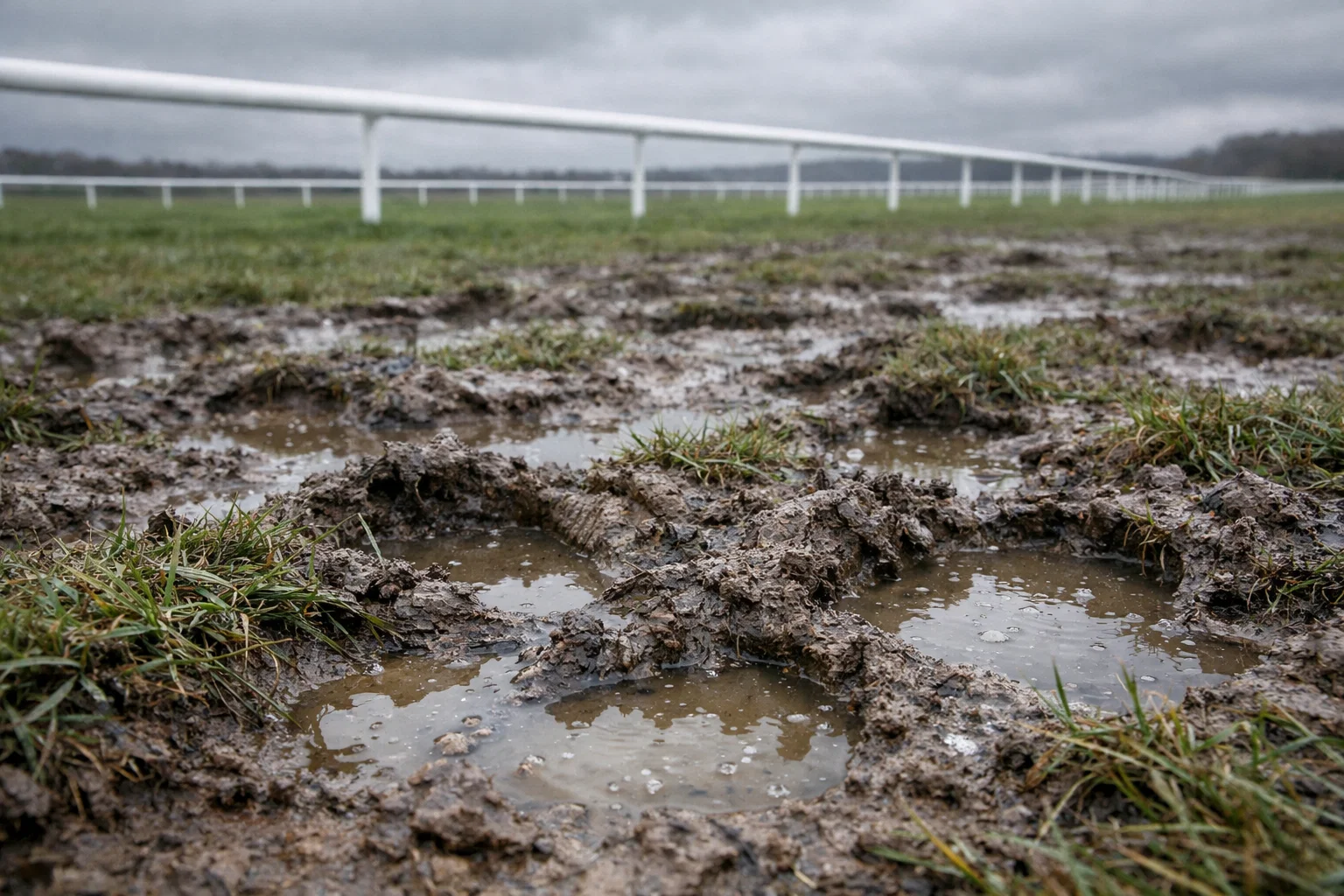
Before the jockey mounts, before the market opens, before anyone thinks about odds or draw positions, there is the ground. Going conditions are the single biggest driver of non-runners in British racing. A shift from Good to Soft overnight can strip half a dozen entries from a card. A week of rain can turn an entire Jump fixture into a survival exercise for specialists. The ground beneath tells you who’s leaving the racecard — and if you’re not checking the going report before you check the odds, you’re starting your analysis from the wrong end.
The connection between going and non-runners isn’t speculative. It’s measurable, seasonal, and — with a little attention — predictable. Trainers know their horses’ ground preferences better than anyone, and when the conditions turn against a horse, the decision to withdraw is often made without hesitation. Understanding how that decision works, and what triggers it, gives you an early warning system that most casual punters ignore.
How Going Conditions Cause Non-Runners in UK Racing — More on this topic at horse racing non runners.
The UK Going Scale: From Hard to Heavy
The official UK going scale runs from Hard at one extreme to Heavy at the other, with several gradations in between. For Flat racing, the full range is: Hard, Firm, Good to Firm, Good, Good to Soft, Soft, Heavy. For Jump racing, the scale is the same but the typical operating range skews wetter — you’ll rarely see a Jump fixture on Hard or Firm ground, while Good to Soft and Soft are the bread and butter of the winter programme.
The going description is determined by the Clerk of the Course at each racecourse, using a combination of a GoingStick reading (a penetrometer that measures the resistance and moisture of the turf), visual inspection, and local knowledge of how the ground at that particular track behaves. The official going is published before declarations and updated on raceday morning, sometimes more than once if conditions change overnight or if the course has been watered.
What matters for non-runners is not the going itself, but the mismatch between the going and a horse’s preferences. A horse bred and trained for fast ground — long, low action, often a Flat sprinter or miler — can struggle on Soft or Heavy going. The deeper ground saps stamina, alters stride length, and increases the risk of injury. Conversely, a horse that thrives in testing conditions — sometimes described as a “mudlark” — may be withdrawn from a card that’s dried out to Good to Firm, because the fast surface jars its joints and negates its stamina advantage.
Trainers monitor going reports obsessively in the days before a race. Many will declare a horse at the 48-hour stage based on a forecast, then withdraw on the morning of the race if the going has shifted against them. This is entirely within the rules and is considered good horsemanship — running a horse on unsuitable ground risks injury and poor performance, neither of which serves the animal or the owner. But for punters, it means the racecard you studied on Thursday evening might look different by Saturday morning.
The going scale also interacts with watering policies. On the Flat, racecourses routinely water the track in dry spells to maintain Good ground, which most trainers prefer. If the watering is insufficient — or if unexpected rain turns watered ground into something heavier than intended — the going can shift rapidly, triggering a wave of withdrawals from horses declared on the expectation of faster conditions.
The Numbers: How Going Drives Withdrawals
The relationship between going and non-runners is not just anecdotal — it’s backed by hard data. According to the BHA’s November 2024 Racing Report, 78% of Jump fixtures in the first three months of 2024 took place on Soft or Heavy ground, compared with a three-year average of 48%. That exceptional concentration of testing ground was the primary driver behind an elevated non-runner rate during that period.
The logic is direct. When three-quarters of Jump fixtures are on Soft or Heavy, every trainer with a horse that needs better ground faces the same choice: run on unsuitable conditions, or withdraw. Most choose to withdraw. The result is smaller fields, more non-runners per card, and a racing programme that skews heavily toward horses with proven wet-ground form. For punters, this concentration creates both risk and opportunity — risk because your carefully selected entries may not run, opportunity because the horses that do run are more likely to be genuinely suited to the conditions.
The data also shows that going-driven non-runners tend to cluster. They don’t arrive one at a time; they come in waves. A going change announced at 8am on raceday can produce three or four withdrawals within the hour. This clustering effect means that the Rule 4 deductions from multiple non-runners can stack up quickly, and the remaining field — already smaller than declared — may look very different from the one you analysed the night before.
Flat racing sees a similar dynamic in reverse. Prolonged dry spells in midsummer can produce Firm or even Hard going, which triggers withdrawals from horses that need cut in the ground. The 2018 and 2022 summers were notable examples, with several major Flat meetings losing significant numbers of runners to fast ground. Watering mitigates this to an extent, but no amount of irrigation can fully replicate the natural softness that some horses require.
Seasonal Patterns: Winter Jumps vs Summer Flat
The seasonal split in British racing creates two distinct going profiles, each with its own non-runner dynamics.
Winter Jump racing runs from October to April, with the heaviest concentration between November and March. This is the wet season, and the going at most tracks spends the majority of the winter between Good to Soft and Heavy. Non-runners driven by ground conditions peak during this period, particularly in January and February when prolonged rain can leave courses waterlogged for weeks. Average Jump field sizes in 2025 sat at 7.84 runners per race — already modest — and going-driven withdrawals can easily knock that figure down to six or five on the worst days.
Summer Flat racing, running from April to October, operates on different terrain. The going is typically faster, ranging from Good to Firm to Good, with occasional dips to Good to Soft after rain. Non-runners on the Flat are more often driven by ground that’s too fast rather than too soft, though the effect is usually less dramatic than the winter equivalent. Flat field sizes averaged 8.90 in 2025, providing a slightly larger buffer against the impact of individual withdrawals.
The transition periods — late March/early April and late September/October — are the most volatile for going-related non-runners. These are the weeks when the weather is least predictable, when trainers are most uncertain about conditions, and when a single overnight rain event can shift the going by two descriptions. It’s no coincidence that ante-post punters at Cheltenham (mid-March) and on the Flat’s autumn programme (October) face the highest going-related withdrawal risk.
Understanding these seasonal patterns doesn’t eliminate the risk, but it helps you price it. If you’re betting on a Jump card in January, expect the going to be testing and factor in the possibility of ground-driven non-runners. If you’re backing a Flat horse in July, check whether the course has been watering and whether your horse has form on fast ground. The ground beneath tells you who’s leaving the racecard — the season tells you what kind of ground to expect.
Check the Going Before You Check the Odds
Going conditions are not a footnote on the racecard — they’re the opening chapter. Before you assess form, before you evaluate the draw, before you look at the odds, check the going. If it’s shifted overnight, check again in the morning. If it’s shifted on the morning of the race, expect non-runners. The ground beneath tells you who’s leaving the racecard, and the earlier you check it, the less likely you are to be caught out by a withdrawal that changes everything.
See also Horse Racing Field Sizes and Non-Runners.
